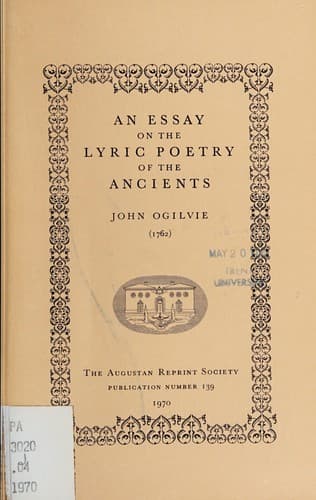
An Essay on the Lyric Poetry of the Ancients — John Shaqi
An Essay on the Lyric Poetry of the AncientsOgilvie, John
History
An Essay on the Lyric Poetry of the Ancients
Ogilvie, John
Classical poetry -- History and criticism
[Footnote 13: Elle ne doit pas s’en tenir a la simple
representation du vrai reel, qui rarement seroit agreable; elle
doit s’elever jusqu’au _vrai ideal_, qui tend’ a embellir le vrai,
tel qu’il est dans la nature, et qui produit dans la Poesie comme
dans la Peinture, le derniere point de perfeftion, &c. Mem. de
Lit. ub. sup.]
Though we must acknowledge, that the poetic representations of a _golden
age_ are chimerical, and that descriptions of this kind were not always
measured by the standard of truth; yet it must be allowed at the same
time, that at a period when Manners were uniform and natural, the
Eclogue, whose principal excellence lies in exhibiting simple and lively
pictures of common objects and common characters, was brought at once to
a state of greater perfection by the persons who introduced it, than it
could have arrived at in a more improved and enlightned aera.
You will observe, my Lord, that these circumstances were all of them
unfavourable to Lyric Poetry. The Poet in this branch of his Art
proposed as his principal aim to excite Admiration, and his mind without
the assistance of critical skill was left to the unequal task of
presenting succeeding ages with the rudiments of Science. He was at
liberty indeed to range through the ideal world, and to collect images
from every quarter; but in this research he proceeded without a guide,
and his imagination like a fiery courser with loose reins was left to
pursue that path into which it deviated by accident, or was enticed by
temptation. In short, Pastoral Poetry takes in only a few objects, and
is characterized by that simplicity, tenderness, and delicacy which were
happily and easily united in the work of an ancient Shepherd. He had
little use for the rules of criticism, because he was not much exposed
to the danger of infringing them. The Lyric Poet on the other hand took
a more diversified and extensive range, and his imagination required a
strong and steady rein to correct its vehemence, and restrain its
rapidity. Though therefore we can conceive without difficulty, that the
Shepherd in his poetic effusions might contemplate only the _external
objects_ which were presented to him, yet we cannot so readily believe
that the mind in framing a Theogony, or in assigning distinct provinces
to the Powers who were supposed to preside over Nature, could in its
first Essays proceed with so calm and deliberate a pace through the
fields of invention, as that its work should be the perfect pattern of
just and corrected composition.
Public-domain text, read in full here on John Shaqi.
Reviews
Reviews
No reviews yet
Be the first to share your thoughts on this work.
Join the Discussion
Join the discussion
Sign in to leave a comment or review.
Sign InorCreate an account