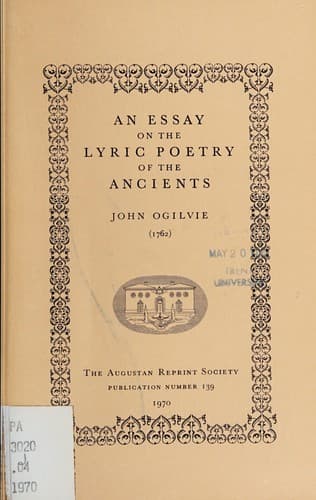
An Essay on the Lyric Poetry of the AncientsOgilvie, John
History
An Essay on the Lyric Poetry of the Ancients
Ogilvie, John
Classical poetry -- History and criticism
Such was the situation of Greece, when Linus, Orpheus, and Museus, the
first Poets whose names have reached posterity, made their appearance on
the theatre of life. These writers undertook the difficult task of
reforming their countrymen, and of laying down a theological and
philosophical system[16]. --We are informed by Diogenes Laertius, that
Linus, the Father of Grecian Poetry, was the son of Mercury and the Muse
Urania, and that he sung of the Generation of the world, of the course
of the sun and moon, of the origin of animals, and of the principles of
vegetation[17]. He taught, says the same Author, that all things were
formed at one time, and that they were jumbled together in a Chaos, till
the operation of a Mind introduced regularity.
[Footnote 16: Authors are not agreed as to the Persons who
introduced into Greece the principles of philosophy. Tatian will
have it that the Greek Philosophy came originally from Ægypt.
Orat. con. Graec. While Laertius (who certainly might have been
better informed) will allow Foreigners to have had no share in it.
He ascribes its origin to Linus, and says expressly, Αφ’ Ἑλληνων
ηρξε φιλοσοφια ἡς και αυτο το ονομα την Βαρβαρον απεστραπτε
προσηγοριαν. Laer. in Prœm.]
[Footnote 17: This account of the subjects on which Linus wrote,
suggests a further prejudice in favour of Laertius’s opinion as to
the origin of Greek Philosophy. He has preserved the first line of
his Poem.
Ην ποτε χρονος οὑτος εν ὡ ἁμα παντ’ επεφυκει. Id. ibid.]
After all, however, we must acknowledge, that so complex, so
diversified, and so ingenious a system as the Greek Theology, was too
much for an _uninstructed_ Genius, however exuberant, to have conceived
in its full extent. Accordingly we are told, that both Orpheus and
Museus travelled into Ægypt, and infused the traditionary learning of a
cultivated people into the minds of their own illiterate countrymen[18].
To do this the more effectually, they composed Hymns, or short sonnets,
in which their meaning was couched under the veil of beautiful allegory,
that their lessons might at once arrest the imagination, and be
impressed upon the Memory[19]. This, my Lord, we are informed by the
great Critic, was the first dress in which Poetry made its
appearance[20].
[Footnote 18: Herod. Lib. I. c. 49.]
[Footnote 19: Univ. Hist. Vol. VI. p. 221.]
[Footnote 20: Οἱ μεν γαρ σεμνοτεροι τας καλας εμιμουντο πραξεις
και τας των τοιουτων τυχας‧ οἱ δε ευτελεστεροι τας των φαυλων
πρωτον ψογους ποιουντες, ὡσπερ ἑτεροι ὙΜΝΟΥΣ και ΕΓΚΩΜΙΑ. Arist.
Poet. c. 4.]
Public-domain text, read in full here on John Shaqi.
Reviews
Reviews
No reviews yet
Be the first to share your thoughts on this work.
Join the Discussion
Join the discussion
Sign in to leave a comment or review.
Sign InorCreate an account