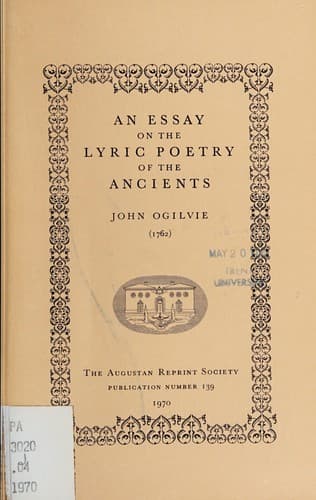
An Essay on the Lyric Poetry of the AncientsOgilvie, John
History
An Essay on the Lyric Poetry of the Ancients
Ogilvie, John
Classical poetry -- History and criticism
[Footnote 44:
_Liberum & Musas, Veneremque & illi
Semper hærentem puerum canebat,
Et Lycum nigris oculis nigroque
Crine decorum._ Carm. Lib. I. Od. 32.]
Your Lordship needs not be told, that the Roman Poet who had the
advantage of improving upon so many originals, takes in a greater
variety of subjects than any of his predecessors, and runs into more
diffuse and diversified measure. I have said, my Lord, that his subjects
are more diversified, because in the character of a Lyric Poet we must
consider him as a professed imitator both of Anacreon and of Pindar. In
the former point of view he falls under our immediate cognisance; in the
latter we shall take a view of him afterwards, when we come to examine
the works of that great Original, whose example he follows.
The Reader will observe, that in the shorter Odes of Horace there is
commonly one leading thought, which is finely enlivened with the graces
of description. A constant Unity of sentiment is therefore preserved in
each of them, and the abrupt starts and sallies of passion are so
artfully interwoven with the principal subject, that upon a review of
the whole piece, we find it to be a perfect imitation of Nature. This
Poet (whose judgment appears to have been equal to his imagination) is
particularly careful to observe propriety in his most irregular
excursions, and the vivacity of his passion is justified by the
circumstances in which he is supposed to be placed. The diction of these
poems is likewise adapted with great accuracy to the sentiment, as it is
generally concise, forcible, and expressive. Brevity of language ought
indeed particularly to characterise this species of the Ode, in which
the Poet writes from immediate feeling, and is intensely animated by his
subject. Delicacy is likewise indispensibly requisite, because the
reader is apt to be disgusted with the least appearance of constraint or
harshness in a poem, whose principal excellence lies in the happy and
elegant turn of a pointed reflection. In short, little sallies and
picturesque epithets have a fine effect in pieces of this kind, as by
the former the passions are forcibly inflamed, and by the latter their
effects are feelingly exposed.
Of all these delicate beauties of composition, the Odes of Horace abound
with pregnant and striking examples. Sometimes he discovers the strength
of his passion, when he is endeavouring to forget it, by a sudden and
lively turn which is wholly unexpected. Thus he tells Lydia,
_Non si me satis audias,
Speres perpetuum dulcia barbare
Lædentem oscula, quæ Venus
Quinta parte sui nectaris imbuit[45]._
[Footnote 45: Carm. Lib. I. Od. 13.]
Sometimes his pictures are heightned with beautiful imagery, and he
seizeth the imagination before he appeals to reason. Thus, when he is
advising his friend not to mourn any longer for a man who was dead,
instead of proposing the subject immediately he says,
Public-domain text, read in full here on John Shaqi.
Reviews
Reviews
No reviews yet
Be the first to share your thoughts on this work.
Join the Discussion
Join the discussion
Sign in to leave a comment or review.
Sign InorCreate an account