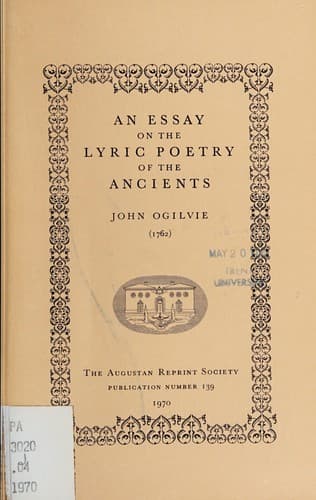
An Essay on the Lyric Poetry of the AncientsOgilvie, John
History
An Essay on the Lyric Poetry of the Ancients
Ogilvie, John
Classical poetry -- History and criticism
These looser and shorter measures distinguish this branch of the Ode
from the Hymn which was composed in heroic measure[52], and from the
Pindaric Ode (as it is commonly called) to which the dithyrambique or
more diversified stanza was particularly appropriated. Of the shorter
Ode therefore it may be said with propriety,
_Son stile impetueux souvent marche au hazarde
Chez un beau disordre est un effect de l’art[53]._
[Footnote 52: Aristotle expressly mentions this circumstance, when
he explains the Origin of the Drama. Παραφανεισας δε της Τραγωδιας
και Κωμωδιας, οἱ εφ’ ἑκατερον τη ποιησεν ἁρμωντες κατα την οικειαν
φυσιν οἱ μεν αντι των Ιαμβων, Κωμωδοποιοι εγενοντο‧ οἱ δε αντι των
Επων τραγωδιδασκαλοι, δια τω μειζω και ενεμοτερα τα σχηματα ειναι
ταυτα εκεινων. Arist. Poet. c. 4.]
[Footnote 53: Boil. Art. Poet.]
Thus, my Lord, we have taken a view of the Lyric poetry of the Ancients,
as it appeared originally in the works of the earliest Poets, and as it
was afterwards employed to enliven a train of more elegant and delicate
sentiment. I have attempted, in the course of this enquiry, to follow
the lights which Antiquity throws on this subject as closely as
possible, to explain facts by placing them in connection, and to
illustrate reasoning by example.
Your Lordship’s acquaintance with the principles of civil Government,
and your experience of the effects of education have enabled you to
observe the _character_, which the Manners _of an age_ stamp upon the
productions of the Authors who live in it. Experience will convince us,
that these general revolutions resemble more nearly than we are apt to
imagine at first view, the circumstances of an Individual at the
different periods of life. In one age he is captivated by the beauties
of description, at another he is fond of the deductions of Philosophy;
his opinions vary with his years, and his actions, as directed by these,
are proportionably diversified. In all these circumstances however, the
original bias which he received from Nature remains unalterable, and the
peculiarity of his character appears conspicuous, notwithstanding the
accidental diversity of fluctuating sentiments. It is to be expected in
such a situation, that changes similar to these will usually take place
in arts which are susceptible of perpetual mutation; and of this a
particular instance is exhibited in the preceding detail. Another branch
of this subject remains to be considered, and on this I shall give your
Lordship the trouble of perusing a few remarks in a subsequent letter.
Permit me only to observe, from what hath already been advanced, that
the ingredients of Genius are often bestowed by Nature, when the polish
of Art is wanted to mould the original materials into elegant
proportion. He who possesseth the former in the highest degree may be a
Shakespear or an Æschylus; but both were united in forming the more
perfect characters of Demosthenes and Homer.
LETTER II.
Public-domain text, read in full here on John Shaqi.
Reviews
Reviews
No reviews yet
Be the first to share your thoughts on this work.
Join the Discussion
Join the discussion
Sign in to leave a comment or review.
Sign InorCreate an account