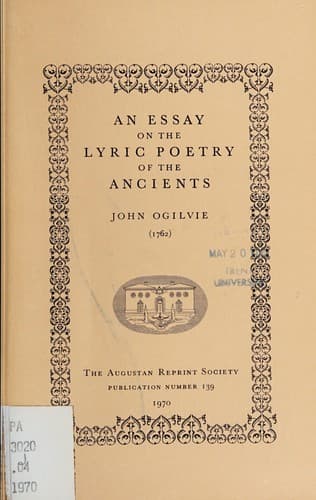
An Essay on the Lyric Poetry of the AncientsOgilvie, John
History
An Essay on the Lyric Poetry of the Ancients
Ogilvie, John
Classical poetry -- History and criticism
These different ingredients, which enter into the mind of a real agent,
ought likewise to be nicely estimated as to the degrees in which they
predominate, before we could be properly qualified to judge of their
influence on his external appearance. As it is evidently impossible that
we can ever be thoroughly apprised of the former, it is therefore
obvious that our judgment of the latter must be always imperfect. On the
contrary, we are never at a loss to conceive a just idea of one simple
expression, because the Original from which the Copy is drawn exists in
our own mind. We are likewise naturally taught to distinguish properly
the insignia of imaginary creatures. Thus Fear is always known by her
_bristled hair_, Admiration by his _erected eyes_, Time has his _scythe_
and his _hour-glass_, and Fortune (unchangeable in one sense) stands
_blind_ on the _globe_, to which she was exalted by Cebes[82].
[Footnote 82: Cebet. Tab.]
I ought, my Lord, to apologize for the length of this Digression on the
nature of allegorical Persons; a subject which I have treated more
particularly, as I do not remember to have seen it canvassed minutely by
any Writer either ancient or modern.
I shall only observe further on this head, that though a Poet is seldom
in hazard of being grossly faulty, with respect to the dress and
insignia of his personages, yet intemperate imagination will induce him
to use this noble figure too frequently by personifying objects of small
comparative importance; or by leaving the simple and natural path, to
entangle himself in the labyrinth of Fiction. This is the fault which
we have already found to characterise the writings of the first Lyric
Poets, from which we should find it an hard task to vindicate their
successors, even in the most improved state of ancient learning. Instead
of producing examples of this intemperance, which the Greek Theology was
peculiarly calculated to indulge, I shall only observe in general, that
we are mistaken in thinking that the Genius of a Poet is indicated by
the diversified incidents which enter into his Fable. True Genius, even
in its most early productions, be discovered rather by _vivid_ and
_picturesque descriptions_, than by any circumstances however
extraordinary in the _narration_ of _events_. It is no difficult matter
to conceive a series of fictitious incidents, and to connect them
together in one story, though it requires judgment to do this in such a
manner, as that the whole may have some happy and continued allusion to
truth. We can imagine, for instance, with great ease something as
impossible as Ariosto’s Magician pursuing the man who had taken off his
head. But it will be found a much more difficult task, either to throw
out one of those strokes of Nature which penetrate the heart, and cleave
it with terror and with pity; or to paint Thought in such striking
colours, as to render it immediately visible to the eye[83].
Public-domain text, read in full here on John Shaqi.
Reviews
Reviews
No reviews yet
Be the first to share your thoughts on this work.
Join the Discussion
Join the discussion
Sign in to leave a comment or review.
Sign InorCreate an account