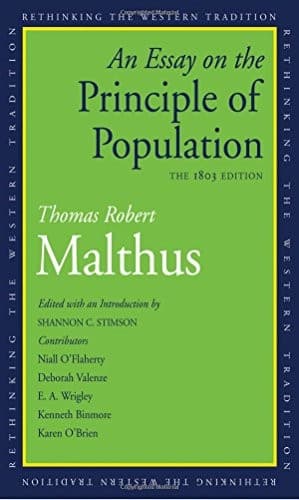
An Essay on the Principle of PopulationMalthus, T. R. (Thomas Robert)
Philosophy
An Essay on the Principle of Population
Malthus, T. R. (Thomas Robert)
Population
It is evident, that if trade and foreign commerce were held in great
honour in China, from the plenty of labourers, and the cheapness of
labour, she might work up manufactures for foreign sale to an immense
amount. It is equally evident that from the great bulk of provisions
and the amazing extent of her inland territory she could not in return
import such a quantity as would be any sensible addition to the annual
stock of subsistence in the country. Her immense amount of
manufactures, therefore, she would exchange, chiefly, for luxuries
collected from all parts of the world. At present, it appears, that no
labour whatever is spared in the production of food. The country is
rather over-people in proportion to what its stock can employ, and
labour is, therefore, so abundant, that no pains are taken to abridge
it. The consequence of this is, probably, the greatest production of
food that the soil can possibly afford, for it will be generally
observed, that processes for abridging labour, though they may enable a
farmer to bring a certain quantity of grain cheaper to market, tend
rather to diminish than increase the whole produce; and in agriculture,
therefore, may, in some respects, be considered rather as private than
public advantages.
An immense capital could not be employed in China in preparing
manufactures for foreign trade without taking off so many labourers
from agriculture as to alter this state of things, and in some degree
to diminish the produce of the country. The demand for manufacturing
labourers would naturally raise the price of labour, but as the
quantity of subsistence would not be increased, the price of provisions
would keep pace with it, or even more than keep pace with it if the
quantity of provisions were really decreasing. The country would be
evidently advancing in wealth, the exchangeable value of the annual
produce of its land and labour would be annually augmented, yet the
real funds for the maintenance of labour would be stationary, or even
declining, and, consequently, the increasing wealth of the nation would
rather tend to depress than to raise the condition of the poor. With
regard to the command over the necessaries and comforts of life, they
would be in the same or rather worse state than before; and a great
part of them would have exchanged the healthy labours of agriculture
for the unhealthy occupations of manufacturing industry.
Public-domain text, read in full here on John Shaqi.
Reviews
Reviews
No reviews yet
Be the first to share your thoughts on this work.
Elsewhere in the archive
Join the Discussion
Join the discussion
Sign in to leave a comment or review.
Sign InorCreate an account