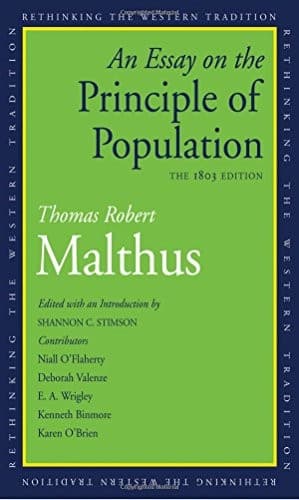
An Essay on the Principle of PopulationMalthus, T. R. (Thomas Robert)
Philosophy
An Essay on the Principle of Population
Malthus, T. R. (Thomas Robert)
Population
I would not by any means be understood to say that the former system
either could or ought to have continued. The increasing price of
butchers' meat is a natural and inevitable consequence of the general
progress of cultivation; but I cannot help thinking, that the present
great demand for butchers' meat of the best quality, and the quantity
of good land that is in consequence annually employed to produce it,
together with the great number of horses at present kept for pleasure,
are the chief causes that have prevented the quantity of human food in
the country from keeping pace with the generally increased fertility of
the soil; and a change of custom in these respects would, I have little
doubt, have a very sensible effect on the quantity of subsistence in
the country, and consequently on its population.
The employment of much of the most fertile land in grating, the
improvements in agricultural instruments, the increase of large farms,
and particularly the diminution of the number of cottages throughout
the kingdom, all concur to prove, that there are not probably so many
persons employed in agricultural labour now as at the period of the
Revolution. Whatever increase of population, therefore, has taken
place, must be employed almost wholly in manufactures, and it is well
known that the failure of some of these manufactures, merely from the
caprice of fashion, such as the adoption of muslins instead of silks,
or of shoe-strings and covered buttons, instead of buckles and metal
buttons, combined with the restraints in the market of labour arising
from corporation and parish laws, have frequently driven thousands on
charity for support. The great increase of the poor rates is, indeed,
of itself a strong evidence that the poor have not a greater command of
the necessaries and conveniences of life, and if to the consideration,
that their condition in this respect is rather worse than better, be
added the circumstance, that a much greater proportion of them is
employed in large manufactories, unfavourable both to health and
virtue, it must be acknowledged, that the increase of wealth of late
years has had no tendency to increase the happiness of the labouring
poor.
That every increase of the stock or revenue of a nation cannot be
considered as an increase of the real funds for the maintenance of
labour and, therefore, cannot have the same good effect upon the
condition of the poor, will appear in a strong light if the argument be
applied to China.
Dr Adam Smith observes that China has probably long been as rich as the
nature of her laws and institutions will admit, but that with other
laws and institutions, and if foreign commerce were had in honour, she
might still be much richer. The question is, would such an increase of
wealth be an increase of the real funds for the maintenance of labour,
and consequently tend to place the lower classes of people in China in
a state of greater plenty?
Public-domain text, read in full here on John Shaqi.
Reviews
Reviews
No reviews yet
Be the first to share your thoughts on this work.
Elsewhere in the archive
Join the Discussion
Join the discussion
Sign in to leave a comment or review.
Sign InorCreate an account