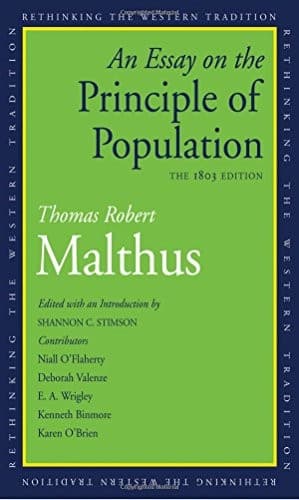
An Essay on the Principle of PopulationMalthus, T. R. (Thomas Robert)
Philosophy
An Essay on the Principle of Population
Malthus, T. R. (Thomas Robert)
Population
A question seems naturally to arise here whether the exchangeable value
of the annual produce of the land and labour be the proper definition
of the wealth of a country, or whether the gross produce of the land,
according to the French economists, may not be a more accurate
definition. Certain it is that every increase of wealth, according to
the definition of the economists, will be an increase of the funds for
the maintenance of labour, and consequently will always tend to
ameliorate the condition of the labouring poor, though an increase of
wealth, according to Dr Adam Smith's definition, will by no means
invariably have the same tendency. And yet it may not follow from this
consideration that Dr Adam Smith's definition is not just. It seems in
many respects improper to exclude the clothing and lodging of a whole
people from any part of their revenue. Much of it may, indeed, be of
very trivial and unimportant value in comparison with the food of the
country, yet still it may be fairly considered as a part of its
revenue; and, therefore, the only point in which I should differ from
Dr Adam Smith is where he seems to consider every increase of the
revenue or stock of a society as an increase of the funds for the
maintenance of labour, and consequently as tending always to ameliorate
the condition of the poor.
The fine silks and cottons, the laces, and other ornamental luxuries of
a rich country, may contribute very considerably to augment the
exchangeable value of its annual produce; yet they contribute but in a
very small degree to augment the mass of happiness in the society, and
it appears to me that it is with some view to the real utility of the
produce that we ought to estimate the productiveness or
unproductiveness of different sorts of labour. The French economists
consider all labour employed in manufactures as unproductive. Comparing
it with the labour employed upon land, I should be perfectly disposed
to agree with them, but not exactly for the reasons which they give.
They say that labour employed upon land is productive because the
produce, over and above completely paying the labourer and the farmer,
affords a clear rent to the landlord, and that the labour employed upon
a piece of lace is unproductive because it merely replaces the
provisions that the workman had consumed, and the stock of his
employer, without affording any clear rent whatever. But supposing the
value of the wrought lace to be such as that, besides paying in the
most complete manner the workman and his employer, it could afford a
clear rent to a third person, it appears to me that, in comparison with
the labour employed upon land, it would be still as unproductive as
ever. Though, according to the reasoning used by the French economists,
the man employed in the manufacture of lace would, in this case, seem
to be a productive labourer. Yet according to their definition of the
wealth of a state, he ought not to be considered in that light. He will
Public-domain text, read in full here on John Shaqi.
Reviews
Reviews
No reviews yet
Be the first to share your thoughts on this work.
Elsewhere in the archive
Join the Discussion
Join the discussion
Sign in to leave a comment or review.
Sign InorCreate an account