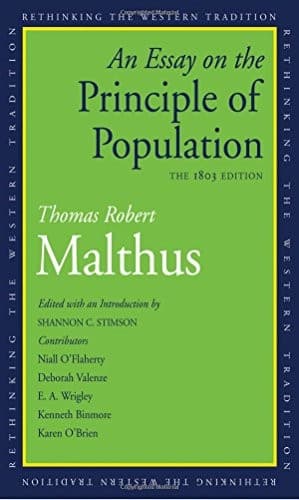
An Essay on the Principle of PopulationMalthus, T. R. (Thomas Robert)
Philosophy
An Essay on the Principle of Population
Malthus, T. R. (Thomas Robert)
Population
have added nothing to the gross produce of the land: he has consumed a
portion of this gross produce, and has left a bit of lace in return;
and though he may sell this bit of lace for three times the quantity of
provisions that he consumed whilst he was making it, and thus be a very
productive labourer with regard to himself, yet he cannot be considered
as having added by his labour to any essential part of the riches of
the state. The clear rent, therefore, that a certain produce can
afford, after paying the expenses of procuring it, does not appear to
be the sole criterion, by which to judge of the productiveness or
unproductiveness to a state of any particular species of labour.
Suppose that two hundred thousand men, who are now employed in
producing manufactures that only tend to gratify the vanity of a few
rich people, were to be employed upon some barren and uncultivated
lands, and to produce only half the quantity of food that they
themselves consumed; they would be still more productive labourers with
regard to the state than they were before, though their labour, so far
from affording a rent to a third person, would but half replace the
provisions used in obtaining the produce. In their former employment
they consumed a certain portion of the food of the country and left in
return some silks and laces. In their latter employment they consumed
the same quantity of food and left in return provision for a hundred
thousand men. There can be little doubt which of the two legacies would
be the most really beneficial to the country, and it will, I think, be
allowed that the wealth which supported the two hundred thousand men
while they were producing silks and laces would have been more usefully
employed in supporting them while they were producing the additional
quantity of food.
A capital employed upon land may be unproductive to the individual that
employs it and yet be highly productive to the society. A capital
employed in trade, on the contrary, may be highly productive to the
individual, and yet be almost totally unproductive to the society: and
this is the reason why I should call manufacturing labour unproductive,
in comparison of that which is employed in agriculture, and not for the
reason given by the French economists. It is, indeed, almost impossible
to see the great fortunes that are made in trade, and the liberality
with which so many merchants live, and yet agree in the statement of
the economists, that manufacturers can only grow rich by depriving
themselves of the funds destined for their support. In many branches of
trade the profits are so great as would allow of a clear rent to a
third person; but as there is no third person in the case, and as all
the profits centre in the master manufacturer, or merchant, he seems to
have a fair chance of growing rich, without much privation; and we
consequently see large fortunes acquired in trade by persons who have
not been remarked for their parsimony.
Public-domain text, read in full here on John Shaqi.
Reviews
Reviews
No reviews yet
Be the first to share your thoughts on this work.
Elsewhere in the archive
Join the Discussion
Join the discussion
Sign in to leave a comment or review.
Sign InorCreate an account