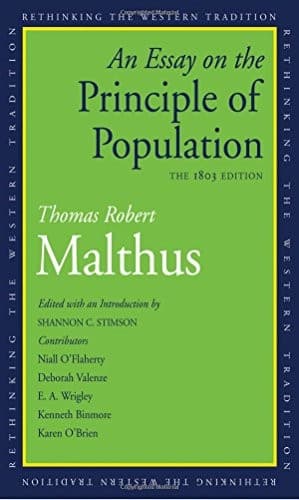
An Essay on the Principle of PopulationMalthus, T. R. (Thomas Robert)
Philosophy
An Essay on the Principle of Population
Malthus, T. R. (Thomas Robert)
Population
I cannot quit this curious subject of the difficulty arising from
population, a subject that appears to me to deserve a minute
investigation and able discussion much beyond my power to give it,
without taking notice of an extraordinary passage in Dr Price's two
volumes of Observations. Having given some tables on the probabilities
of life, in towns and in the country, he says (Vol. II, p. 243):
From this comparison, it appears with how much truth great cities have
been called the graves of mankind. It must also convince all who
consider it, that according to the observation, at the end of the
fourth essay, in the former volume, it is by no means strictly proper
to consider our diseases as the original intention of nature. They are,
without doubt, in general our own creation. Were there a country where
the inhabitants led lives entirely natural and virtuous, few of them
would die without measuring out the whole period of present existence
allotted to them; pain and distemper would be unknown among them, and
death would come upon them like a sleep, in consequence of no other
cause than gradual and unavoidable decay.
I own that I felt myself obliged to draw a very opposite conclusion
from the facts advanced in Dr Price's two volumes. I had for some time
been aware that population and food increased in different ratios, and
a vague opinion had been floating in my mind that they could only be
kept equal by some species of misery or vice, but the perusal of Dr
Price's two volumes of Observations, after that opinion had been
conceived, raised it at once to conviction. With so many facts in his
view to prove the extraordinary rapidity with which population
increases when unchecked, and with such a body of evidence before him
to elucidate even the manner by which the general laws of nature
repress a redundant population, it is perfectly inconceivable to me how
he could write the passage that I have quoted. He was a strenuous
advocate for early marriages, as the best preservative against vicious
manners. He had no fanciful conceptions about the extinction of the
passion between the sexes, like Mr Godwin, nor did he ever think of
eluding the difficulty in the ways hinted at by Mr Condorcet. He
frequently talks of giving the prolifick powers of nature room to exert
themselves. Yet with these ideas, that his understanding could escape
from the obvious and necessary inference that an unchecked population
would increase, beyond comparison, faster than the earth, by the best
directed exertions of man, could produce food for its support, appears
to me as astonishing as if he had resisted the conclusion of one of the
plainest propositions of Euclid.
Public-domain text, read in full here on John Shaqi.
Reviews
Reviews
No reviews yet
Be the first to share your thoughts on this work.
Elsewhere in the archive
Join the Discussion
Join the discussion
Sign in to leave a comment or review.
Sign InorCreate an account