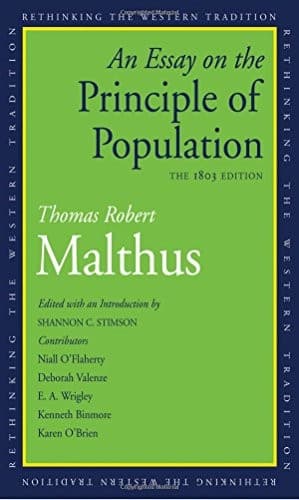
An Essay on the Principle of PopulationMalthus, T. R. (Thomas Robert)
Philosophy
An Essay on the Principle of Population
Malthus, T. R. (Thomas Robert)
Population
Daily experience proves that the labour employed in trade and
manufactures is sufficiently productive to individuals, but it
certainly is not productive in the same degree to the state. Every
accession to the food of a country tends to the immediate benefit of
the whole society; but the fortunes made in trade tend but in a remote
and uncertain manner to the same end, and in some respects have even a
contrary tendency. The home trade of consumption is by far the most
important trade of every nation. China is the richest country in the
world, without any other. Putting then, for a moment, foreign trade out
of the question, the man who, by an ingenious manufacture, obtains a
double portion out of the old stock of provisions, will certainly not
to be so useful to the state as the man who, by his labour, adds a
single share to the former stock. The consumable commodities of silks,
laces, trinkets, and expensive furniture, are undoubtedly a part of the
revenue of the society; but they are the revenue only of the rich, and
not of the society in general. An increase in this part of the revenue
of a state, cannot, therefore, be considered of the same importance as
an increase of food, which forms the principal revenue of the great
mass of the people.
Foreign commerce adds to the wealth of a state, according to Dr Adam
Smith's definition, though not according to the definition of the
economists. Its principal use, and the reason, probably, that it has in
general been held in such high estimation is that it adds greatly to
the external power of a nation or to its power of commanding the labour
of other countries; but it will be found, upon a near examination, to
contribute but little to the increase of the internal funds for the
maintenance of labour, and consequently but little to the happiness of
the greatest part of society. In the natural progress of a state
towards riches, manufactures, and foreign commerce would follow, in
their order, the high cultivation of the soil. In Europe, this natural
order of things has been inverted, and the soil has been cultivated
from the redundancy of manufacturing capital, instead of manufactures
rising from the redundancy of capital employed upon land. The superior
encouragement that has been given to the industry of the towns, and the
consequent higher price that is paid for the labour of artificers than
for the labour of those employed in husbandry, are probably the reasons
why so much soil in Europe remains uncultivated. Had a different policy
been pursued throughout Europe, it might undoubtedly have been much
more populous than at present, and yet not be more incumbered by its
population.
Public-domain text, read in full here on John Shaqi.
Reviews
Reviews
No reviews yet
Be the first to share your thoughts on this work.
Elsewhere in the archive
Join the Discussion
Join the discussion
Sign in to leave a comment or review.
Sign InorCreate an account