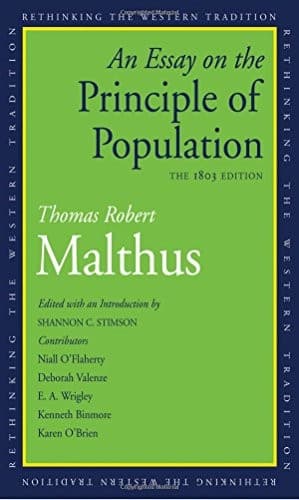
An Essay on the Principle of PopulationMalthus, T. R. (Thomas Robert)
Philosophy
An Essay on the Principle of Population
Malthus, T. R. (Thomas Robert)
Population
The sorrows of life necessary to soften and humanize the heart--The
excitement of social sympathy often produce characters of a higher
order than the mere possessors of talents--Moral evil probably
necessary to the production of moral excellence--Excitements from
intellectual wants continually kept up by the infinite variety of
nature, and the obscurity that involves metaphysical subjects--The
difficulties in revelation to be accounted for upon this principle--The
degree of evidence which the scriptures contain, probably, best suited
to the improvements of the human faculties, and the moral amelioration
of mankind--The idea that mind is created by excitements seems to
account for the existence of natural and moral evil.
The sorrows and distresses of life form another class of excitements,
which seem to be necessary, by a peculiar train of impressions, to
soften and humanize the heart, to awaken social sympathy, to generate
all the Christian virtues, and to afford scope for the ample exertion
of benevolence. The general tendency of an uniform course of prosperity
is rather to degrade than exalt the character. The heart that has never
known sorrow itself will seldom be feelingly alive to the pains and
pleasures, the wants and wishes, of its fellow beings. It will seldom
be overflowing with that warmth of brotherly love, those kind and
amiable affections, which dignify the human character even more than
the possession of the highest talents. Talents, indeed, though
undoubtedly a very prominent and fine feature of mind, can by no means
be considered as constituting the whole of it. There are many minds
which have not been exposed to those excitements that usually form
talents, that have yet been vivified to a high degree by the
excitements of social sympathy. In every rank of life, in the lowest as
frequently as in the highest, characters are to be found overflowing
with the milk of human kindness, breathing love towards God and man,
and, though without those peculiar powers of mind called talents,
evidently holding a higher rank in the scale of beings than many who
possess them. Evangelical charity, meekness, piety, and all that class
of virtues distinguished particularly by the name of Christian virtues
do not seem necessarily to include abilities; yet a soul possessed of
these amiable qualities, a soul awakened and vivified by these
delightful sympathies, seems to hold a nearer commerce with the skies
than mere acuteness of intellect.
Public-domain text, read in full here on John Shaqi.
Reviews
Reviews
No reviews yet
Be the first to share your thoughts on this work.
Elsewhere in the archive
Join the Discussion
Join the discussion
Sign in to leave a comment or review.
Sign InorCreate an account