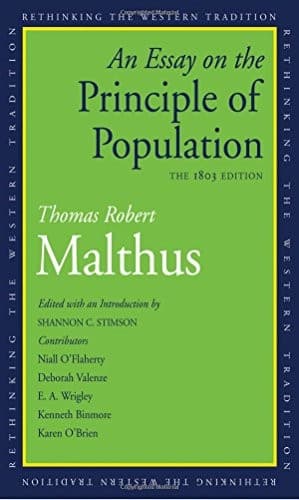
An Essay on the Principle of PopulationMalthus, T. R. (Thomas Robert)
Philosophy
An Essay on the Principle of Population
Malthus, T. R. (Thomas Robert)
Population
The greatest talents have been frequently misapplied and have produced
evil proportionate to the extent of their powers. Both reason and
revelation seem to assure us that such minds will be condemned to
eternal death, but while on earth, these vicious instruments performed
their part in the great mass of impressions, by the disgust and
abhorrence which they excited. It seems highly probable that moral evil
is absolutely necessary to the production of moral excellence. A being
with only good placed in view may be justly said to be impelled by a
blind necessity. The pursuit of good in this case can be no indication
of virtuous propensities. It might be said, perhaps, that infinite
Wisdom cannot want such an indication as outward action, but would
foreknow with certainly whether the being would choose good or evil.
This might be a plausible argument against a state of trial, but will
not hold against the supposition that mind in this world is in a state
of formation. Upon this idea, the being that has seen moral evil and
has felt disapprobation and disgust at it is essentially different from
the being that has seen only good. They are pieces of clay that have
received distinct impressions: they must, therefore, necessarily be in
different shapes; or, even if we allow them both to have the same
lovely form of virtue, it must be acknowledged that one has undergone
the further process, necessary to give firmness and durability to its
substance, while the other is still exposed to injury, and liable to be
broken by every accidental impulse. An ardent love and admiration of
virtue seems to imply the existence of something opposite to it, and it
seems highly probable that the same beauty of form and substance, the
same perfection of character, could not be generated without the
impressions of disapprobation which arise from the spectacle of moral
evil.
When the mind has been awakened into activity by the passions, and the
wants of the body, intellectual wants arise; and the desire of
knowledge, and the impatience under ignorance, form a new and important
class of excitements. Every part of nature seems peculiarly calculated
to furnish stimulants to mental exertion of this kind, and to offer
inexhaustible food for the most unremitted inquiry. Our mortal Bard
says of Cleopatra:
Custom cannot stale
Her infinite variety.
The expression, when applied to any one object, may be considered as a
poetical amplification, but it is accurately true when applied to
nature. Infinite variety seems, indeed, eminently her characteristic
feature. The shades that are here and there blended in the picture give
spirit, life, and prominence to her exuberant beauties, and those
roughnesses and inequalities, those inferior parts that support the
superior, though they sometimes offend the fastidious microscopic eye
of short-sighted man, contribute to the symmetry, grace, and fair
proportion of the whole.
Public-domain text, read in full here on John Shaqi.
Reviews
Reviews
No reviews yet
Be the first to share your thoughts on this work.
Elsewhere in the archive
Join the Discussion
Join the discussion
Sign in to leave a comment or review.
Sign InorCreate an account