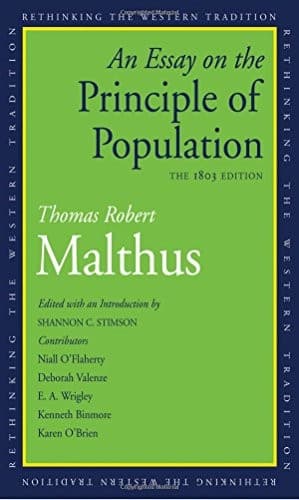
An Essay on the Principle of PopulationMalthus, T. R. (Thomas Robert)
Philosophy
An Essay on the Principle of Population
Malthus, T. R. (Thomas Robert)
Population
It is by no means one of the wisest sayings of Solomon that 'there is
no new thing under the sun.' On the contrary, it is probable that were
the present system to continue for millions of years, continual
additions would be making to the mass of human knowledge, and yet,
perhaps, it may be a matter of doubt whether what may be called the
capacity of mind be in any marked and decided manner increasing. A
Socrates, a Plato, or an Aristotle, however confessedly inferior in
knowledge to the philosophers of the present day, do not appear to have
been much below them in intellectual capacity. Intellect rises from a
speck, continues in vigour only for a certain period, and will not
perhaps admit while on earth of above a certain number of impressions.
These impressions may, indeed, be infinitely modified, and from these
various modifications, added probably to a difference in the
susceptibility of the original germs, arise the endless diversity of
character that we see in the world; but reason and experience seem both
to assure us that the capacity of individual minds does not increase in
proportion to the mass of existing knowledge. (It is probable that no
two grains of wheat are exactly alike. Soil undoubtedly makes the
principal difference in the blades that spring up, but probably not
all. It seems natural to suppose some sort of difference in the
original germs that are afterwards awakened into thought, and the
extraordinary difference of susceptibility in very young children seems
to confirm the supposition.)
The finest minds seem to be formed rather by efforts at original
thinking, by endeavours to form new combinations, and to discover new
truths, than by passively receiving the impressions of other men's
ideas. Could we suppose the period arrived, when there was not further
hope of future discoveries, and the only employment of mind was to
acquire pre-existing knowledge, without any efforts to form new and
original combinations, though the mass of human knowledge were a
thousand times greater than it is at present, yet it is evident that
one of the noblest stimulants to mental exertion would have ceased; the
finest feature of intellect would be lost; everything allied to genius
would be at an end; and it appears to be impossible, that, under such
circumstances, any individuals could possess the same intellectual
energies as were possessed by a Locke, a Newton, or a Shakespeare, or
even by a Socrates, a Plato, an Aristotle or a Homer.
Public-domain text, read in full here on John Shaqi.
Reviews
Reviews
No reviews yet
Be the first to share your thoughts on this work.
Elsewhere in the archive
Join the Discussion
Join the discussion
Sign in to leave a comment or review.
Sign InorCreate an account