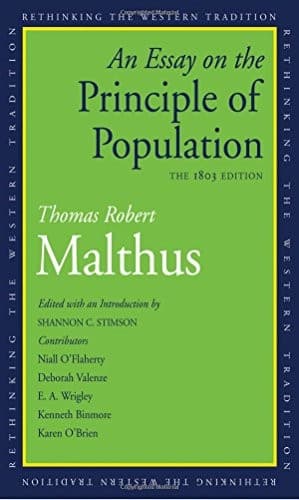
An Essay on the Principle of PopulationMalthus, T. R. (Thomas Robert)
Philosophy
An Essay on the Principle of Population
Malthus, T. R. (Thomas Robert)
Population
If a revelation from heaven of which no person could feel the smallest
doubt were to dispel the mists that now hang over metaphysical
subjects, were to explain the nature and structure of mind, the
affections and essences of all substances, the mode in which the
Supreme Being operates in the works of the creation, and the whole plan
and scheme of the Universe, such an accession of knowledge so obtained,
instead of giving additional vigour and activity to the human mind,
would in all probability tend to repress future exertion and to damp
the soaring wings of intellect.
For this reason I have never considered the doubts and difficulties
that involve some parts of the sacred writings as any ardent against
their divine original. The Supreme Being might, undoubtedly, have
accompanied his revelations to man by such a succession of miracles,
and of such a nature, as would have produced universal overpowering
conviction and have put an end at once to all hesitation and
discussion. But weak as our reason is to comprehend the plans of the
great Creator, it is yet sufficiently strong to see the most striking
objections to such a revelation. From the little we know of the
structure of the human understanding, we must be convinced that an
overpowering conviction of this kind, instead of tending to the
improvement and moral amelioration of man, would act like the touch of
a torpedo on all intellectual exertion and would almost put an end to
the existence of virtue. If the scriptural denunciations of eternal
punishment were brought home with the same certainty to every man's
mind as that the night will follow the day, this one vast and gloomy
idea would take such full possession of the human faculties as to leave
no room for any other conceptions, the external actions of men would be
all nearly alike, virtuous conduct would be no indication of virtuous
disposition, vice and virtue would be blended together in one common
mass, and though the all-seeing eye of God might distinguish them they
must necessarily make the same impressions on man, who can judge only
from external appearances. Under such a dispensation, it is difficult
to conceive how human beings could be formed to a detestation of moral
evil, and a love and admiration of God, and of moral excellence.
Public-domain text, read in full here on John Shaqi.
Reviews
Reviews
No reviews yet
Be the first to share your thoughts on this work.
Elsewhere in the archive
Join the Discussion
Join the discussion
Sign in to leave a comment or review.
Sign InorCreate an account