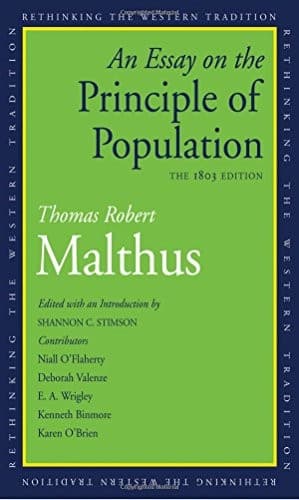
An Essay on the Principle of PopulationMalthus, T. R. (Thomas Robert)
Philosophy
An Essay on the Principle of Population
Malthus, T. R. (Thomas Robert)
Population
Life is, generally speaking, a blessing independent of a future state.
It is a gift which the vicious would not always be ready to throw away,
even if they had no fear of death. The partial pain, therefore, that is
inflicted by the supreme Creator, while he is forming numberless beings
to a capacity of the highest enjoyments, is but as the dust of the
balance in comparison of the happiness that is communicated, and we
have every reason to think that there is no more evil in the world than
what is absolutely necessary as one of the ingredients in the mighty
process.
The striking necessity of general laws for the formation of intellect
will not in any respect be contradicted by one or two exceptions, and
these evidently not intended for partial purposes, but calculated to
operate upon a great part of mankind, and through many ages. Upon the
idea that I have given of the formation of mind, the infringement of
the general law of nature, by a divine revelation, will appear in the
light of the immediate hand of God mixing new ingredients in the mighty
mass, suited to the particular state of the process, and calculated to
give rise to a new and powerful train of impressions, tending to
purify, exalt, and improve the human mind. The miracles that
accompanied these revelations when they had once excited the attention
of mankind, and rendered it a matter of most interesting discussion,
whether the doctrine was from God or man, had performed their part, had
answered the purpose of the Creator, and these communications of the
divine will were afterwards left to make their way by their own
intrinsic excellence; and, by operating as moral motives, gradually to
influence and improve, and not to overpower and stagnate the faculties
of man.
It would be, undoubtedly, presumptuous to say that the Supreme Being
could not possibly have effected his purpose in any other way than that
which he has chosen, but as the revelation of the divine will which we
possess is attended with some doubts and difficulties, and as our
reason points out to us the strongest objections to a revelation which
would force immediate, implicit, universal belief, we have surely just
cause to think that these doubts and difficulties are no argument
against the divine origin of the scriptures, and that the species of
evidence which they possess is best suited to the improvement of the
human faculties and the moral amelioration of mankind.
Public-domain text, read in full here on John Shaqi.
Reviews
Reviews
No reviews yet
Be the first to share your thoughts on this work.
Elsewhere in the archive
Join the Discussion
Join the discussion
Sign in to leave a comment or review.
Sign InorCreate an account