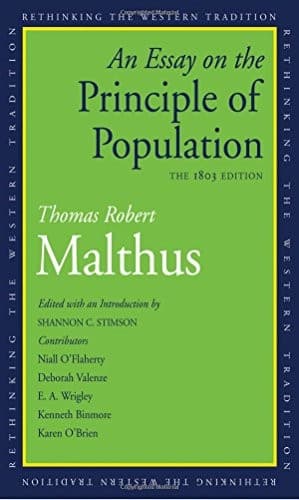
An Essay on the Principle of PopulationMalthus, T. R. (Thomas Robert)
Philosophy
An Essay on the Principle of Population
Malthus, T. R. (Thomas Robert)
Population
Our ideas of virtue and vice are not, perhaps, very accurate and
well-defined; but few, I think, would call an action really virtuous
which was performed simply and solely from the dread of a very great
punishment or the expectation of a very great reward. The fear of the
Lord is very justly said to be the beginning of wisdom, but the end of
wisdom is the love of the Lord and the admiration of moral good. The
denunciations of future punishment contained in the scriptures seem to
be well calculated to arrest the progress of the vicious and awaken the
attention of the careless, but we see from repeated experience that
they are not accompanied with evidence of such a nature as to overpower
the human will and to make men lead virtuous lives with vicious
dispositions, merely from a dread of hereafter. A genuine faith, by
which I mean a faith that shews itself in it the virtues of a truly
Christian life, may generally be considered as an indication of an
amiable and virtuous disposition, operated upon more by love than by
pure unmixed fear.
When we reflect on the temptations to which man must necessarily be
exposed in this world, from the structure of his frame, and the
operation of the laws of nature, and the consequent moral certainty
that many vessels will come out of this mighty creative furnace in
wrong shapes, it is perfectly impossible to conceive that any of these
creatures of God's hand can be condemned to eternal suffering. Could we
once admit such an idea, it our natural conceptions of goodness and
justice would be completely overthrown, and we could no longer look up
to God as a merciful and righteous Being. But the doctrine of life and
Mortality which was brought to light by the gospel, the doctrine that
the end of righteousness is everlasting life, but that the wages of sin
are death, is in every respect just and merciful, and worthy of the
great Creator. Nothing can appear more consonant to our reason than
that those beings which come out of the creative process of the world
in lovely and beautiful forms should be crowned with immortality, while
those which come out misshapen, those whose minds are not suited to a
purer and happier state of existence, should perish and be condemned to
mix again with their original clay. Eternal condemnation of this kind
may be considered as a species of eternal punishment, and it is not
wonderful that it should be represented, sometimes, under images of
suffering. But life and death, salvation and destruction, are more
frequently opposed to each other in the New Testament than happiness
and misery. The Supreme Being would appear to us in a very different
view if we were to consider him as pursuing the creatures that had
offended him with eternal hate and torture, instead of merely
condemning to their original insensibility those beings that, by the
operation of general laws, had not been formed with qualities suited to
a purer state of happiness.
Public-domain text, read in full here on John Shaqi.
Reviews
Reviews
No reviews yet
Be the first to share your thoughts on this work.
Elsewhere in the archive
Join the Discussion
Join the discussion
Sign in to leave a comment or review.
Sign InorCreate an account