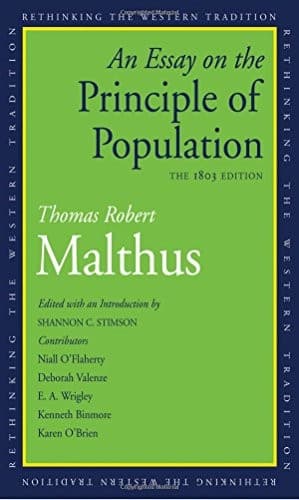
An Essay on the Principle of PopulationMalthus, T. R. (Thomas Robert)
Philosophy
An Essay on the Principle of Population
Malthus, T. R. (Thomas Robert)
Population
In the rudest state of mankind, in which hunting is the principal
occupation, and the only mode of acquiring food; the means of
subsistence being scattered over a large extent of territory, the
comparative population must necessarily be thin. It is said that the
passion between the sexes is less ardent among the North American
Indians, than among any other race of men. Yet, notwithstanding this
apathy, the effort towards population, even in this people, seems to be
always greater than the means to support it. This appears, from the
comparatively rapid population that takes place, whenever any of the
tribes happen to settle in some fertile spot, and to draw nourishment
from more fruitful sources than that of hunting; and it has been
frequently remarked that when an Indian family has taken up its abode
near any European settlement, and adopted a more easy and civilized
mode of life, that one woman has reared five, or six, or more children;
though in the savage state it rarely happens that above one or two in a
family grow up to maturity. The same observation has been made with
regard to the Hottentots near the Cape. These facts prove the superior
power of population to the means of subsistence in nations of hunters,
and that this power always shews itself the moment it is left to act
with freedom.
It remains to inquire whether this power can be checked, and its
effects kept equal to the means of subsistence, without vice or misery.
The North American Indians, considered as a people, cannot justly be
called free and equal. In all the accounts we have of them, and,
indeed, of most other savage nations, the women are represented as much
more completely in a state of slavery to the men than the poor are to
the rich in civilized countries. One half the nation appears to act as
Helots to the other half, and the misery that checks population falls
chiefly, as it always must do, upon that part whose condition is lowest
in the scale of society. The infancy of man in the simplest state
requires considerable attention, but this necessary attention the women
cannot give, condemned as they are to the inconveniences and hardships
of frequent change of place and to the constant and unremitting
drudgery of preparing every thing for the reception of their tyrannic
lords. These exertions, sometimes during pregnancy or with children at
their backs, must occasion frequent miscarriages, and prevent any but
the most robust infants from growing to maturity. Add to these
hardships of the women the constant war that prevails among savages,
and the necessity which they frequently labour under of exposing their
aged and helpless parents, and of thus violating the first feelings of
nature, and the picture will not appear very free from the blot of
misery. In estimating the happiness of a savage nation, we must not fix
our eyes only on the warrior in the prime of life: he is one of a
hundred: he is the gentleman, the man of fortune, the chances have been
Public-domain text, read in full here on John Shaqi.
Reviews
Reviews
No reviews yet
Be the first to share your thoughts on this work.
Join the Discussion
Join the discussion
Sign in to leave a comment or review.
Sign InorCreate an account