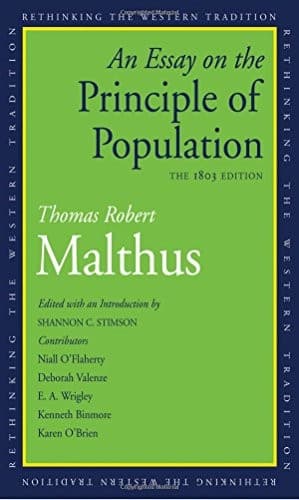
An Essay on the Principle of PopulationMalthus, T. R. (Thomas Robert)
Philosophy
An Essay on the Principle of Population
Malthus, T. R. (Thomas Robert)
Population
Hume, in his essay on the populousness of ancient and modern nations,
when he intermingles, as he says, an inquiry concerning causes with
that concerning facts, does not seem to see with his usual penetration
how very little some of the causes he alludes to could enable him to
form any judgement of the actual population of ancient nations. If any
inference can be drawn from them, perhaps it should be directly the
reverse of what Hume draws, though I certainly ought to speak with
great diffidence in dissenting from a man who of all others on such
subjects was the least likely to be deceived by first appearances. If I
find that at a certain period in ancient history, the encouragements to
have a family were great, that early marriages were consequently very
prevalent, and that few persons remained single, I should infer with
certainty that population was rapidly increasing, but by no means that
it was then actually very great, rather; indeed, the contrary, that it
was then thin and that there was room and food for a much greater
number. On the other hand, if I find that at this period the
difficulties attending a family were very great, that, consequently,
few early marriages took place, and that a great number of both sexes
remained single, I infer with certainty that population was at a stand,
and, probably, because the actual population was very great in
proportion to the fertility of the land and that there was scarcely
room and food for more. The number of footmen, housemaids, and other
persons remaining unmarried in modern states, Hume allows to be rather
an argument against their population. I should rather draw a contrary
inference and consider it an argument of their fullness, though this
inference is not certain, because there are many thinly inhabited
states that are yet stationary in their population. To speak,
therefore, correctly, perhaps it may be said that the number of
unmarried persons in proportion to the whole number, existing at
different periods, in the same or different states will enable us to
judge whether population at these periods was increasing, stationary,
or decreasing, but will form no criterion by which we can determine the
actual population.
Public-domain text, read in full here on John Shaqi.
Reviews
Reviews
No reviews yet
Be the first to share your thoughts on this work.
Join the Discussion
Join the discussion
Sign in to leave a comment or review.
Sign InorCreate an account