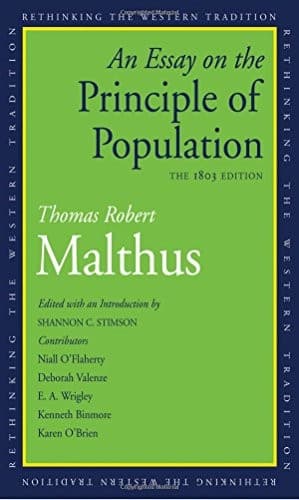
An Essay on the Principle of PopulationMalthus, T. R. (Thomas Robert)
Philosophy
An Essay on the Principle of Population
Malthus, T. R. (Thomas Robert)
Population
It should be remembered always that there is an essential difference
between food and those wrought commodities, the raw materials of which
are in great plenty. A demand for these last will not fail to create
them in as great a quantity as they are wanted. The demand for food has
by no means the same creative power. In a country where all the fertile
spots have been seized, high offers are necessary to encourage the
farmer to lay his dressing on land from which he cannot expect a
profitable return for some years. And before the prospect of advantage
is sufficiently great to encourage this sort of agricultural
enterprise, and while the new produce is rising, great distresses may
be suffered from the want of it. The demand for an increased quantity
of subsistence is, with few exceptions, constant everywhere, yet we see
how slowly it is answered in all those countries that have been long
occupied.
The poor laws of England were undoubtedly instituted for the most
benevolent purpose, but there is great reason to think that they have
not succeeded in their intention. They certainly mitigate some cases of
very severe distress which might otherwise occur, yet the state of the
poor who are supported by parishes, considered in all its
circumstances, is very far from being free from misery. But one of the
principal objections to them is that for this assistance which some of
the poor receive, in itself almost a doubtful blessing, the whole class
of the common people of England is subjected to a set of grating,
inconvenient, and tyrannical laws, totally inconsistent with the
genuine spirit of the constitution. The whole business of settlements,
even in its present amended state, is utterly contradictory to all
ideas of freedom. The parish persecution of men whose families are
likely to become chargeable, and of poor women who are near lying-in,
is a most disgraceful and disgusting tyranny. And the obstructions
continuity occasioned in the market of labour by these laws have a
constant tendency to add to the difficulties of those who are
struggling to support themselves without assistance.
These evils attendant on the poor laws are in some degree irremediable.
If assistance be to be distributed to a certain class of people, a
power must be given somewhere of discriminating the proper objects and
of managing the concerns of the institutions that are necessary, but
any great interference with the affairs of other people is a species of
tyranny, and in the common course of things the exercise of this power
may be expected to become grating to those who are driven to ask for
support. The tyranny of Justices, Church-wardens, and Overseers, is a
common complaint among the poor, but the fault does not lie so much in
these persons, who probably, before they were in power, were not worse
than other people, but in the nature of all such institutions.
Public-domain text, read in full here on John Shaqi.
Reviews
Reviews
No reviews yet
Be the first to share your thoughts on this work.
Join the Discussion
Join the discussion
Sign in to leave a comment or review.
Sign InorCreate an account