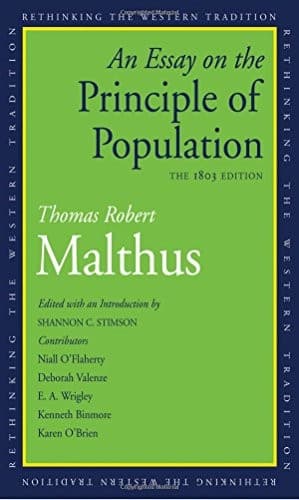
An Essay on the Principle of PopulationMalthus, T. R. (Thomas Robert)
Philosophy
An Essay on the Principle of Population
Malthus, T. R. (Thomas Robert)
Population
Lastly, for cases of extreme distress, county workhouses might be
established, supported by rates upon the whole kingdom, and free for
persons of all counties, and indeed of all nations. The fare should be
hard, and those that were able obliged to work. It would be desirable
that they should not be considered as comfortable asylums in all
difficulties, but merely as places where severe distress might find
some alleviation. A part of these houses might be separated, or others
built for a most beneficial purpose, which has not been infrequently
taken notice of, that of providing a place where any person, whether
native or foreigner, might do a day's work at all times and receive the
market price for it. Many cases would undoubtedly be left for the
exertion of individual benevolence.
A plan of this kind, the preliminary of which should be an abolition of
all the present parish laws, seems to be the best calculated to
increase the mass of happiness among the common people of England. To
prevent the recurrence of misery, is, alas! beyond the power of man. In
the vain endeavour to attain what in the nature of things is
impossible, we now sacrifice not only possible but certain benefits. We
tell the common people that if they will submit to a code of tyrannical
regulations, they shall never be in want. They do submit to these
regulations. They perform their part of the contract, but we do not,
nay cannot, perform ours, and thus the poor sacrifice the valuable
blessing of liberty and receive nothing that can be called an
equivalent in return.
Notwithstanding, then, the institution of the poor laws in England, I
think it will be allowed that considering the state of the lower
classes altogether, both in the towns and in the country, the
distresses which they suffer from the want of proper and sufficient
food, from hard labour and unwholesome habitations, must operate as a
constant check to incipient population.
To these two great checks to population, in all long occupied
countries, which I have called the preventive and the positive checks,
may be added vicious customs with respect to women, great cities,
unwholesome manufactures, luxury, pestilence, and war.
All these checks may be fairly resolved into misery and vice. And that
these are the true causes of the slow increase of population in all the
states of modern Europe, will appear sufficiently evident from the
comparatively rapid increase that has invariably taken place whenever
these causes have been in any considerable degree removed.
CHAPTER 6
New colonies--Reasons for their rapid increase--North American
Colonies--Extraordinary instance of increase in the back
settlements--Rapidity with which even old states recover the ravages of
war, pestilence, famine, or the convulsions of nature.
Public-domain text, read in full here on John Shaqi.
Reviews
Reviews
No reviews yet
Be the first to share your thoughts on this work.
Join the Discussion
Join the discussion
Sign in to leave a comment or review.
Sign InorCreate an account