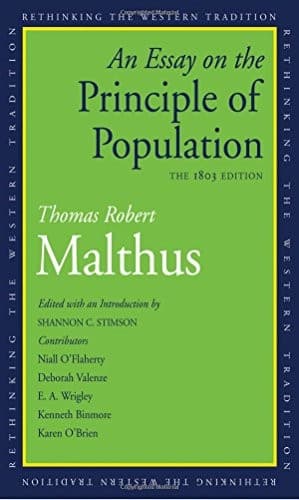
An Essay on the Principle of PopulationMalthus, T. R. (Thomas Robert)
Philosophy
An Essay on the Principle of Population
Malthus, T. R. (Thomas Robert)
Population
A probable cause of epidemics--Extracts from Mr Suessmilch's
tables--Periodical returns of sickly seasons to be expected in certain
cases--Proportion of births to burials for short periods in any country
an inadequate criterion of the real average increase of
population--Best criterion of a permanent increase of population--Great
frugality of living one of the causes of the famines of China and
Indostan--Evil tendency of one of the clauses in Mr Pitt's Poor
Bill--Only one proper way of encouraging population--Causes of the
Happiness of nations--Famine, the last and most dreadful mode by which
nature represses a redundant population--The three propositions
considered as established.
By great attention to cleanliness, the plague seems at length to be
completely expelled from London. But it is not improbable that among
the secondary causes that produce even sickly seasons and epidemics
ought to be ranked a crowded population and unwholesome and
insufficient food. I have been led to this remark, by looking over some
of the tables of Mr Suessmilch, which Dr Price has extracted in one of
his notes to the postscript on the controversy respecting the
population of England and Wales. They are considered as very correct,
and if such tables were general, they would throw great light on the
different ways by which population is repressed and prevented from
increasing beyond the means of subsistence in any country. I will
extract a part of the tables, with Dr Price's remarks.
IN THE KINGDOM OF PRUSSIA, AND DUKEDOM OF LITHUANIA
Proportion Proportion
Births Burials Marriages of Births to of Births to
Marriages Burials
10 Yrs to 1702 21,963 14,718 5,928 37 to 10 150 to 100
5 Yrs to 1716 21,602 11,984 4,968 37 to 10 180 to 100
5 Yrs to 1756 28,392 19,154 5,599 50 to 10 148 to 100
"N.B. In 1709 and 1710, a pestilence carried off 247,733 of the
inhabitants of this country, and in 1736 and 1737, epidemics prevailed,
which again checked its increase."
It may be remarked, that the greatest proportion of births to burials,
was in the five years after the great pestilence.
DUCHY OF POMERANIA
Proportion Proportion
Annual Average Births Burials Marriages of Births to of Births to
Marriages Burials
6 yrs to 1702 6,540 4,647 1,810 36 to 10 140 to 100
6 yrs to 1708 7,455 4,208 1,875 39 to 10 177 to 100
6 yrs to 1726 8,432 5,627 2,131 39 to 10 150 to 100
6 yrs to 1756 12,767 9,281 2,957 43 to 10 137 to 100
Public-domain text, read in full here on John Shaqi.
Reviews
Reviews
No reviews yet
Be the first to share your thoughts on this work.
Join the Discussion
Join the discussion
Sign in to leave a comment or review.
Sign InorCreate an account