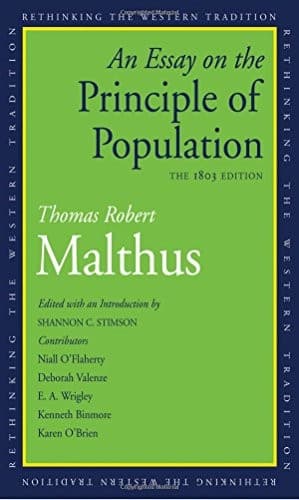
An Essay on the Principle of PopulationMalthus, T. R. (Thomas Robert)
Philosophy
An Essay on the Principle of Population
Malthus, T. R. (Thomas Robert)
Population
The passion between the sexes has appeared in every age to be so nearly
the same that it may always be considered, in algebraic language, as a
given quantity. The great law of necessity which prevents population
from increasing in any country beyond the food which it can either
produce or acquire, is a law so open to our view, so obvious and
evident to our understandings, and so completely confirmed by the
experience of every age, that we cannot for a moment doubt it. The
different modes which nature takes to prevent or repress a redundant
population do not appear, indeed, to us so certain and regular, but
though we cannot always predict the mode we may with certainty predict
the fact. If the proportion of births to deaths for a few years
indicate an increase of numbers much beyond the proportional increased
or acquired produce of the country, we may be perfectly certain that
unless an emigration takes place, the deaths will shortly exceed the
births; and that the increase that had taken place for a few years
cannot be the real average increase of the population of the country.
Were there no other depopulating causes, every country would, without
doubt, be subject to periodical pestilences or famine.
The only true criterion of a real and permanent increase in the
population of any country is the increase of the means of subsistence.
But even, this criterion is subject to some slight variations which
are, however, completely open to our view and observations. In some
countries population appears to have been forced, that is, the people
have been habituated by degrees to live almost upon the smallest
possible quantity of food. There must have been periods in such
counties when population increased permanently, without an increase in
the means of subsistence. China seems to answer to this description. If
the accounts we have of it are to be trusted, the lower classes of
people are in the habit of living almost upon the smallest possible
quantity of food and are glad to get any putrid offals that European
labourers would rather starve than eat. The law in China which permits
parents to expose their children has tended principally thus to force
the population. A nation in this state must necessarily be subject to
famines. Where a country is so populous in proportion to the means of
subsistence that the average produce of it is but barely sufficient to
support the lives of the inhabitants, any deficiency from the badness
of seasons must be fatal. It is probable that the very frugal manner in
which the Gentoos are in the habit of living contributes in some degree
to the famines of Indostan.
Public-domain text, read in full here on John Shaqi.
An Essay on the Principle of Population — John Shaqi
Reviews
Reviews
No reviews yet
Be the first to share your thoughts on this work.
Join the Discussion
Join the discussion
Sign in to leave a comment or review.
Sign InorCreate an account