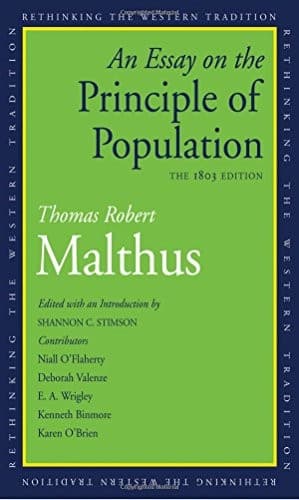
An Essay on the Principle of PopulationMalthus, T. R. (Thomas Robert)
Philosophy
An Essay on the Principle of Population
Malthus, T. R. (Thomas Robert)
Population
Intemperance in every enjoyment defeats its own purpose. A walk in the
finest day through the most beautiful country, if pursued too far, ends
in pain and fatigue. The most wholesome and invigorating food, eaten
with an unrestrained appetite, produces weakness instead of strength.
Even intellectual pleasures, though certainly less liable than others
to satiety, pursued with too little intermission, debilitate the body,
and impair the vigour of the mind. To argue against the reality of
these pleasures from their abuse seems to be hardly just. Morality,
according to Mr Godwin, is a calculation of consequences, or, as
Archdeacon Paley very justly expresses it, the will of God, as
collected from general expediency. According to either of these
definitions, a sensual pleasure not attended with the probability of
unhappy consequences does not offend against the laws of morality, and
if it be pursued with such a degree of temperance as to leave the most
ample room for intellectual attainments, it must undoubtedly add to the
sum of pleasurable sensations in life. Virtuous love, exalted by
friendship, seems to be that sort of mixture of sensual and
intellectual enjoyment particularly suited to the nature of man, and
most powerfully calculated to awaken the sympathies of the soul, and
produce the most exquisite gratifications.
Mr Godwin says, in order to shew the evident inferiority of the
pleasures of sense, 'Strip the commerce of the sexes of all its
attendant circumstances, and it would be generally despised' (Bk. I,
ch. 5; in the third edition, Vol. I, pp. 71-72). He might as well say
to a man who admired trees: strip them of their spreading branches and
lovely foliage, and what beauty can you see in a bare pole? But it was
the tree with the branches and foliage, and not without them, that
excited admiration. One feature of an object may be as distinct, and
excite as different emotions, from the aggregate as any two things the
most remote, as a beautiful woman, and a map of Madagascar. It is 'the
symmetry of person, the vivacity, the voluptuous softness of temper,
the affectionate kindness of feelings, the imagination and the wit' of
a woman that excite the passion of love, and not the mere distinction
of her being female. Urged by the passion of love, men have been driven
into acts highly prejudicial to the general interests of society, but
probably they would have found no difficulty in resisting the
temptation, had it appeared in the form of a woman with no other
attractions whatever but her sex. To strip sensual pleasures of all
their adjuncts, in order to prove their inferiority, is to deprive a
magnet of some of its most essential causes of attraction, and then to
say that it is weak and inefficient.
Public-domain text, read in full here on John Shaqi.
Reviews
Reviews
No reviews yet
Be the first to share your thoughts on this work.
Elsewhere in the archive
Join the Discussion
Join the discussion
Sign in to leave a comment or review.
Sign InorCreate an account