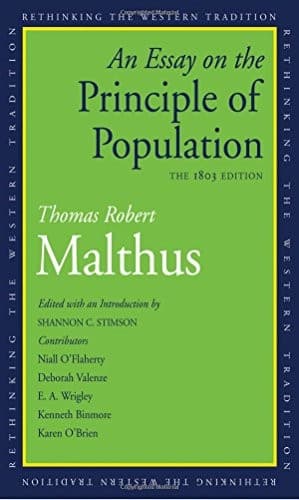
An Essay on the Principle of PopulationMalthus, T. R. (Thomas Robert)
Philosophy
An Essay on the Principle of Population
Malthus, T. R. (Thomas Robert)
Population
In the pursuit of every enjoyment, whether sensual or intellectual,
reason, that faculty which enables us to calculate consequences, is the
proper corrective and guide. It is probable therefore that improved
reason will always tend to prevent the abuse of sensual pleasures,
though it by no means follows that it will extinguish them.
I have endeavoured to expose the fallacy of that argument which infers
an unlimited progress from a partial improvement, the limits of which
cannot be exactly ascertained. It has appeared, I think, that there are
many instances in which a decided progress has been observed, where yet
it would be a gross absurdity to suppose that progress indefinite. But
towards the extinction of the passion between the sexes, no observable
progress whatever has hitherto been made. To suppose such an
extinction, therefore, is merely to offer an unfounded conjecture,
unsupported by any philosophical probabilities.
It is a truth, which history I am afraid makes too clear, that some men
of the highest mental powers have been addicted not only to a moderate,
but even to an immoderate indulgence in the pleasures of sensual love.
But allowing, as I should be inclined to do, notwithstanding numerous
instances to the contrary, that great intellectual exertions tend to
diminish the empire of this passion over man, it is evident that the
mass of mankind must be improved more highly than the brightest
ornaments of the species at present before any difference can take
place sufficient sensibly to affect population. I would by no means
suppose that the mass of mankind has reached its term of improvement,
but the principal argument of this essay tends to place in a strong
point of view the improbability that the lower classes of people in any
country should ever be sufficiently free from want and labour to obtain
any high degree of intellectual improvement.
CHAPTER 12
Mr Godwin's conjecture concerning the indefinite prolongation of human
life--Improper inference drawn from the effects of mental stimulants on
the human frame, illustrated in various instances--Conjectures not
founded on any indications in the past not to be considered as
philosophical conjectures--Mr Godwin's and Mr Condorcet's conjecture
respecting the approach of man towards immortality on earth, a curious
instance of the inconsistency of scepticism.
Mr Godwin's conjecture respecting the future approach of man towards
immortality on earth seems to be rather oddly placed in a chapter which
professes to remove the objection to his system of equality from the
principle of population. Unless he supposes the passion between the
sexes to decrease faster than the duration of life increases, the earth
would be more encumbered than ever. But leaving this difficulty to Mr
Godwin, let us examine a few of the appearances from which the probable
immortality of man is inferred.
Public-domain text, read in full here on John Shaqi.
Reviews
Reviews
No reviews yet
Be the first to share your thoughts on this work.
Elsewhere in the archive
Join the Discussion
Join the discussion
Sign in to leave a comment or review.
Sign InorCreate an account