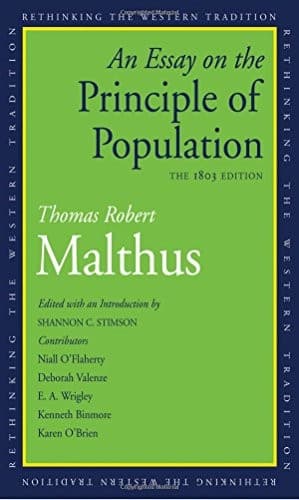
An Essay on the Principle of PopulationMalthus, T. R. (Thomas Robert)
Philosophy
An Essay on the Principle of Population
Malthus, T. R. (Thomas Robert)
Population
To prove the power of the mind over the body, Mr Godwin observes, "How
often do we find a piece of good news dissipating a distemper? How
common is the remark that those accidents which are to the indolent a
source of disease are forgotten and extirpated in the busy and active?
I walk twenty miles in an indolent and half determined temper and am
extremely fatigued. I walk twenty miles full of ardour, and with a
motive that engrosses my soul, and I come in as fresh and as alert as
when I began my journey. Emotion excited by some unexpected word, by a
letter that is delivered to us, occasions the most extraordinary
revolutions in our frame, accelerates the circulation, causes the heart
to palpitate, the tongue to refuse its office, and has been known to
occasion death by extreme anguish or extreme joy. There is nothing
indeed of which the physician is more aware than of the power of the
mind in assisting or reading convalescence."
The instances here mentioned are chiefly instances of the effects of
mental stimulants on the bodily frame. No person has ever for a moment
doubted the near, though mysterious, connection of mind and body. But
it is arguing totally without knowledge of the nature of stimulants to
suppose, either that they can be applied continually with equal
strength, or if they could be so applied, for a time, that they would
not exhaust and wear out the subject. In some of the cases here
noticed, the strength of the stimulus depends upon its novelty and
unexpectedness. Such a stimulus cannot, from its nature, be repeated
often with the same effect, as it would by repetition lose that
property which gives it its strength.
In the other cases, the argument is from a small and partial effect, to
a great and general effect, which will in numberless instances be found
to be a very fallacious mode of reasoning. The busy and active man may
in some degree counteract, or what is perhaps nearer the truth, may
disregard those slight disorders of frame which fix the attention of a
man who has nothing else to think of; but this does not tend to prove
that activity of mind will enable a man to disregard a high fever, the
smallpox, or the plague.
Public-domain text, read in full here on John Shaqi.
Reviews
Reviews
No reviews yet
Be the first to share your thoughts on this work.
Elsewhere in the archive
Join the Discussion
Join the discussion
Sign in to leave a comment or review.
Sign InorCreate an account