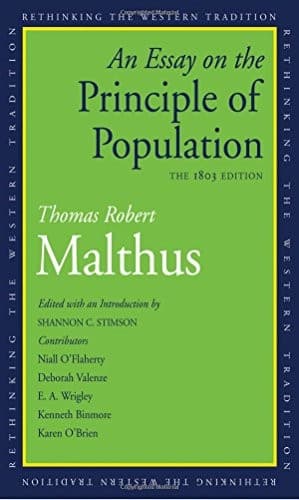
An Essay on the Principle of PopulationMalthus, T. R. (Thomas Robert)
Philosophy
An Essay on the Principle of Population
Malthus, T. R. (Thomas Robert)
Population
It will be said, perhaps, that many discoveries have already taken
place in the world that were totally unforeseen and unexpected. This I
grant to be true; but if a person had predicted these discoveries
without being guided by any analogies or indications from past facts,
he would deserve the name of seer or prophet, but not of philosopher.
The wonder that some of our modern discoveries would excite in the
savage inhabitants of Europe in the times of Theseus and Achilles,
proves but little. Persons almost entirely unacquainted with the powers
of a machine cannot be expected to guess at its effects. I am far from
saying, that we are at present by any means fully acquainted with the
powers of the human mind; but we certainly know more of this instrument
than was known four thousand years ago; and therefore, though not to be
called competent judges, we are certainly much better able than savages
to say what is, or is not, within its grasp. A watch would strike a
savage with as much surprise as a perpetual motion; yet one is to us a
most familiar piece of mechanism, and the other has constantly eluded
the efforts of the most acute intellects. In many instances we are now
able to perceive the causes, which prevent an unlimited improvement in
those inventions, which seemed to promise fairly for it at first. The
original improvers of telescopes would probably think, that as long as
the size of the specula and the length of the tubes could be increased,
the powers and advantages of the instrument would increase; but
experience has since taught us, that the smallness of the field, the
deficiency of light, and the circumstance of the atmosphere being
magnified, prevent the beneficial results that were to be expected from
telescopes of extraordinary size and power. In many parts of knowledge,
man has been almost constantly making some progress; in other parts,
his efforts have been invariably baffled. The savage would not probably
be able to guess at the causes of this mighty difference. Our further
experience has given us some little insight into these causes, and has
therefore enabled us better to judge, if not of what we are to expect
in future, at least of what we are not to expect, which, though
negative, is a very useful piece of information.
As the necessity of sleep seems rather to depend upon the body than the
mind, it does not appear how the improvement of the mind can tend very
greatly to supersede this 'conspicuous infirmity'. A man who by great
excitements on his mind is able to pass two or three nights without
sleep, proportionably exhausts the vigour of his body, and this
diminution of health and strength will soon disturb the operations of
his understanding, so that by these great efforts he appears to have
made no real progress whatever in superseding the necessity of this
species of rest.
Public-domain text, read in full here on John Shaqi.
Reviews
Reviews
No reviews yet
Be the first to share your thoughts on this work.
Elsewhere in the archive
Join the Discussion
Join the discussion
Sign in to leave a comment or review.
Sign InorCreate an account