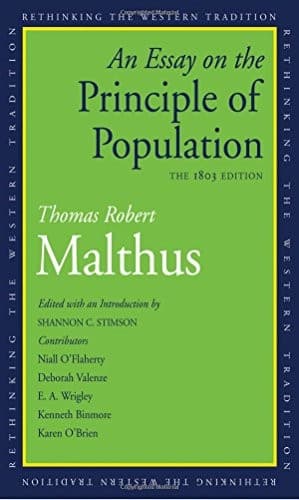
An Essay on the Principle of PopulationMalthus, T. R. (Thomas Robert)
Philosophy
An Essay on the Principle of Population
Malthus, T. R. (Thomas Robert)
Population
There is certainly a sufficiently marked difference in the various
characters of which we have some knowledge, relative to the energies of
their minds, their benevolent pursuits, etc., to enable us to judge
whether the operations of intellect have any decided effect in
prolonging the duration of human life. It is certain that no decided
effect of this kind has yet been observed. Though no attention of any
kind has ever produced such an effect as could be construed into the
smallest semblance of an approach towards immortality, yet of the two,
a certain attention to the body seems to have more effect in this
respect than an attention to the mind. The man who takes his temperate
meals and his bodily exercise, with scrupulous regularity, will
generally be found more healthy than the man who, very deeply engaged
in intellectual pursuits, often forgets for a time these bodily
cravings. The citizen who has retired, and whose ideas, perhaps,
scarcely soar above or extend beyond his little garden, puddling all
the morning about his borders of box, will, perhaps, live as long as
the philosopher whose range of intellect is the most extensive, and
whose views are the clearest of any of his contemporaries. It has been
positively observed by those who have attended to the bills of
mortality that women live longer upon an average than men, and, though
I would not by any means say that their intellectual faculties are
inferior, yet, I think, it must be allowed that, from their different
education, there are not so many women as men, who are excited to
vigorous mental exertion.
As in these and similar instances, or to take a larger range, as in the
great diversity of characters that have existed during some thousand
years, no decided difference has been observed in the duration of human
life from the operation of intellect, the mortality of man on earth
seems to be as completely established, and exactly upon the same
grounds, as any one, the most constant, of the laws of nature. An
immediate act of power in the Creator of the Universe might, indeed,
change one or all of these laws, either suddenly or gradually, but
without some indications of such a change, and such indications do not
exist, it. Is just as unphilosophical to suppose that the life of man
may be prolonged beyond any assignable limits, as to suppose that the
attraction of the earth will gradually be changed into repulsion and
that stones will ultimately rise instead of fall or that the earth will
fly off at a certain period to some more genial and warmer sun.
The conclusion of this chapter presents us, undoubtedly, with a very
beautiful and desirable picture, but like some of the landscapes drawn
from fancy and not imagined with truth, it fails of that interest in
the heart which nature and probability can alone give.
Public-domain text, read in full here on John Shaqi.
Reviews
Reviews
No reviews yet
Be the first to share your thoughts on this work.
Elsewhere in the archive
Join the Discussion
Join the discussion
Sign in to leave a comment or review.
Sign InorCreate an account