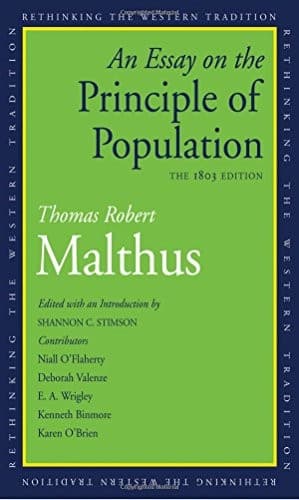
An Essay on the Principle of PopulationMalthus, T. R. (Thomas Robert)
Philosophy
An Essay on the Principle of Population
Malthus, T. R. (Thomas Robert)
Population
I am willing to allow that every voluntary act is preceded by a
decision of the mind, but it is strangely opposite to what I should
conceive to be the just theory upon the subject, and a palpable
contradiction to all experience, to say that the corporal propensities
of man do not act very powerfully, as disturbing forces, in these
decisions. The question, therefore, does not merely depend upon whether
a man may be made to understand a distinct proposition or be convinced
by an unanswerable argument. A truth may be brought home to his
conviction as a rational being, though he may determine to act contrary
to it, as a compound being. The cravings of hunger, the love of liquor,
the desire of possessing a beautiful woman, will urge men to actions,
of the fatal consequences of which, to the general interests of
society, they are perfectly well convinced, even at the very time they
commit them. Remove their bodily cravings, and they would not hesitate
a moment in determining against such actions. Ask them their opinion of
the same conduct in another person, and they would immediately
reprobate it. But in their own case, and under all the circumstances of
their situation with these bodily cravings, the decision of the
compound being is different from the conviction of the rational being.
If this be the just view of the subject, and both theory and experience
unite to prove that it is, almost all Mr Godwin's reasonings on the
subject of coercion in his seventh chapter, will appear to be founded
on error. He spends some time in placing in a ridiculous point of view
the attempt to convince a man's understanding and to clear up a
doubtful proposition in his mind, by blows. Undoubtedly it is both
ridiculous and barbarous, and so is cock-fighting, but one has little
more to do with the real object of human punishments than the other.
One frequent (indeed much too frequent) mode of punishment is death. Mr
Godwin will hardly think this intended for conviction, at least it does
not appear how the individual or the society could reap much future
benefit from an understanding enlightened in this manner.
The principal objects which human punishments have in view are
undoubtedly restraint and example; restraint, or removal, of an
individual member whose vicious habits are likely to be prejudicial to
the society'; and example, which by expressing the sense of the
community with regard to a particular crime, and by associating more
nearly and visibly crime and punishment, holds out a moral motive to
dissuade others from the commission of it.
Public-domain text, read in full here on John Shaqi.
Reviews
Reviews
No reviews yet
Be the first to share your thoughts on this work.
Elsewhere in the archive
Join the Discussion
Join the discussion
Sign in to leave a comment or review.
Sign InorCreate an account