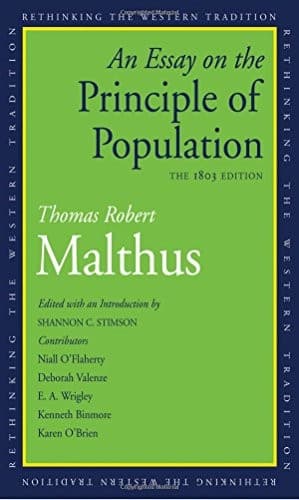
An Essay on the Principle of PopulationMalthus, T. R. (Thomas Robert)
Philosophy
An Essay on the Principle of Population
Malthus, T. R. (Thomas Robert)
Population
Restraint, Mr Godwin thinks, may be permitted as a temporary expedient,
though he reprobates solitary imprisonment, which has certainly been
the most successful, and, indeed, almost the only attempt towards the
moral amelioration of offenders. He talks of the selfish passions that
are fostered by solitude and of the virtues generated in society. But
surely these virtues are not generated in the society of a prison. Were
the offender confined to the society of able and virtuous men he would
probably be more improved than in solitude. But is this practicable? Mr
Godwin's ingenuity is more frequently employed in finding out evils
than in suggesting practical remedies.
Punishment, for example, is totally reprobated. By endeavouring to make
examples too impressive and terrible, nations have, indeed, been led
into the most barbarous cruelties, but the abuse of any practice is not
a good argument against its use. The indefatigable pains taken in this
country to find out a murder, and the certainty of its punishment, has
powerfully contributed to generate that sentiment which is frequent in
the mouths of the common people, that a murder will sooner or later
come to light; and the habitual horror in which murder is in
consequence held will make a man, in the agony of passion, throw down
his knife for fear he should be tempted to use it in the gratification
of his revenge. In Italy, where murderers, by flying to a sanctuary,
are allowed more frequently to escape, the crime has never been held in
the same detestation and has consequently been more frequent. No man,
who is at all aware of the operation of moral motives, can doubt for a
moment, that if every murder in Italy had been invariably punished, the
use of the stiletto in transports of passion would have been
comparatively but little known.
That human laws either do, or can, proportion the punishment accurately
to the offence, no person will have the folly to assert. From the
inscrutability of motives the thing is absolutely impossible, but this
imperfection, though it may be called a species of injustice, is no
valid argument against human laws. It is the lot of man, that he will
frequently have to choose between two evils; and it is a sufficient
reason for the adoption of any institution, that it is the best mode
that suggests itself of preventing greater evils. A continual endeavour
should undoubtedly prevail to make these institutions as perfect as the
nature of them will admit. But nothing is so easy as to find fault with
human institutions; nothing so difficult as to suggest adequate
practical improvements. It is to be lamented, that more men of talents
employ their time in the former occupation than in the latter.
Public-domain text, read in full here on John Shaqi.
Reviews
Reviews
No reviews yet
Be the first to share your thoughts on this work.
Elsewhere in the archive
Join the Discussion
Join the discussion
Sign in to leave a comment or review.
Sign InorCreate an account