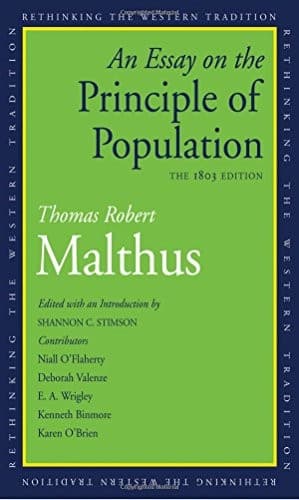
An Essay on the Principle of PopulationMalthus, T. R. (Thomas Robert)
Philosophy
An Essay on the Principle of Population
Malthus, T. R. (Thomas Robert)
Population
Were it of consequence to improve pinks and carnations, though we could
have no hope of raising them as large as cabbages, we might undoubtedly
expect, by successive efforts, to obtain more beautiful specimens than
we at present possess. No person can deny the importance of improving
the happiness of the human species. Every the least advance in this
respect is highly valuable. But an experiment with the human race is
not like an experiment upon inanimate objects. The bursting of a flower
may be a trifle. Another will soon succeed it. But the bursting of the
bonds of society is such a separation of parts as cannot take place
without giving the most acute pain to thousands: and a long time may
elapse, and much misery may be endured, before the wound grows up again.
As the five propositions which I have been examining may be considered
as the corner stones of Mr Godwin's fanciful structure, and, indeed, as
expressing the aim and bent of his whole work, however excellent much
of his detached reasoning may be, he must be considered as having
failed in the great object of his undertaking. Besides the difficulties
arising from the compound nature of man, which he has by no means
sufficiently smoothed, the principal argument against the
perfectibility of man and society remains whole and unimpaired from any
thing that he has advanced. And as far as I can trust my own judgement,
this argument appears to be conclusive, not only against the
perfectibility of man, in the enlarged sense in which Mr Godwin
understands the term, but against any very marked and striking change
for the better, in the form and structure of general society; by which
I mean any great and decided amelioration of the condition of the lower
classes of mankind, the most numerous, and, consequently, in a general
view of the subject, the most important part of the human race. Were I
to live a thousand years, and the laws of nature to remain the same, I
should little fear, or rather little hope, a contradiction from
experience in asserting that no possible sacrifices or exertions of the
rich, in a country which had been long inhabited, could for any time
place the lower classes of the community in a situation equal, with
regard to circumstances, to the situation of the common people about
thirty years ago in the northern States of America.
The lower classes of people in Europe may at some future period be much
better instructed than they are at present; they may be taught to
employ the little spare time they have in many better ways than at the
ale-house; they may live under better and more equal laws than they
have ever hitherto done, perhaps, in any country; and I even conceive
it possible, though not probable that they may have more leisure; but
it is not in the nature of things that they can be awarded such a
quantity of money or subsistence as will allow them all to marry early,
in the full confidence that they shall be able to provide with ease for
a numerous family.
Public-domain text, read in full here on John Shaqi.
Reviews
Reviews
No reviews yet
Be the first to share your thoughts on this work.
Elsewhere in the archive
Join the Discussion
Join the discussion
Sign in to leave a comment or review.
Sign InorCreate an account