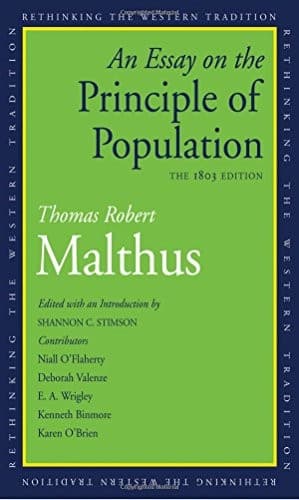
An Essay on the Principle of PopulationMalthus, T. R. (Thomas Robert)
Philosophy
An Essay on the Principle of Population
Malthus, T. R. (Thomas Robert)
Population
CHAPTER 15
Models too perfect may sometimes rather impede than promote
improvement--Mr Godwin's essay on 'Avarice and
Profusion'--Impossibility of dividing the necessary labour of a society
amicably among all--Invectives against labour may produce present evil,
with little or no chance of producing future good--An accession to the
mass of agricultural labour must always be an advantage to the labourer.
Mr Godwin in the preface to his Enquirer, drops a few expressions which
seem to hint at some change in his opinions since he wrote the
Political Justice; and as this is a work now of some years standing, I
should certainly think that I had been arguing against opinions which
the author had himself seen reason to alter, but that in some of the
essays of the Enquirer, Mr Godwin's peculiar mode of thinking appears
in as striking a light as ever.
It has been frequently observed that though we cannot hope to reach
perfection in any thing, yet that it must always be advantageous to us
to place before our eyes the most perfect models. This observation has
a plausible appearance, but is very far from being generally true. I
even doubt its truth in one of the most obvious exemplifications that
would occur. I doubt whether a very young painter would receive so much
benefit, from an attempt to copy a highly finished and perfect picture,
as from copying one where the outlines were more strongly marked and
the manner of laying on the colours was more easily discoverable. But
in cases where the perfection of the model is a perfection of a
different and superior nature from that towards which we should
naturally advance, we shall not always fail in making any progress
towards it, but we shall in all probability impede the progress which
we might have expected to make had we not fixed our eyes upon so
perfect a model. A highly intellectual being, exempt from the infirm
calls of hunger or sleep, is undoubtedly a much more perfect existence
than man, but were man to attempt to copy such a model, he would not
only fail in making any advances towards it; but by unwisely straining
to imitate what was inimitable, he would probably destroy the little
intellect which he was endeavouring to improve.
The form and structure of society which Mr Godwin describes is as
essentially distinct from any forms of society which have hitherto
prevailed in the world as a being that can live without food or sleep
is from a man. By improving society in its present form, we are making
no more advances towards such a state of things as he pictures than we
should make approaches towards a line, with regard to which we were
walking parallel. The question, therefore, is whether, by looking to
such a form of society as our polar star, we are likely to advance or
retard the improvement of the human species? Mr Godwin appears to me to
have decided this question against himself in his essay on 'Avarice and
Profusion' in the Enquirer.
Public-domain text, read in full here on John Shaqi.
Reviews
Reviews
No reviews yet
Be the first to share your thoughts on this work.
Elsewhere in the archive
Join the Discussion
Join the discussion
Sign in to leave a comment or review.
Sign InorCreate an account