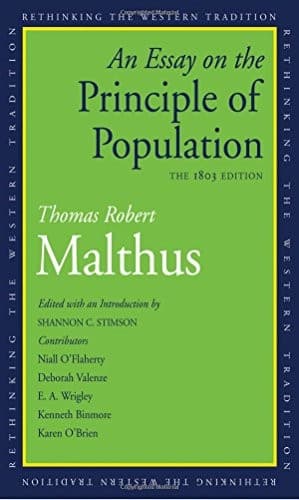
An Essay on the Principle of PopulationMalthus, T. R. (Thomas Robert)
Philosophy
An Essay on the Principle of Population
Malthus, T. R. (Thomas Robert)
Population
The labour created by luxuries, though useful in distributing the
produce of the country, without vitiating the proprietor by power, or
debasing the labourer by dependence, has not, indeed, the same
beneficial effects on the state of the poor. A great accession of work
from manufacturers, though it may raise the price of labour even more
than an increasing demand for agricultural labour, yet, as in this case
the quantity of food in the country may not be proportionably
increasing, the advantage to the poor will be but temporary, as the
price of provisions must necessarily rise in proportion to the price of
labour. Relative to this subject, I cannot avoid venturing a few
remarks on a part of Dr Adam Smith's Wealth of Nations, speaking at the
same time with that diffidence which I ought certainly to feel in
differing from a person so justly celebrated in the political world.
CHAPTER 16
Probable error of Dr Adam Smith in representing every increase of the
revenue or stock of a society as an increase in the funds for the
maintenance of labour--Instances where an increase of wealth can have
no tendency to better the condition of the labouring poor--England has
increased in riches without a proportional increase in the funds for
the maintenance of labour--The state of the poor in China would not be
improved by an increase of wealth from manufactures.
The professed object of Dr Adam Smith's inquiry is the nature and
causes of the wealth of nations. There is another inquiry, however,
perhaps still more interesting, which he occasionally mixes with it; I
mean an inquiry into the causes which affect the happiness of nations
or the happiness and comfort of the lower orders of society, which is
the most numerous class in every nation. I am sufficiency aware of the
near connection of these two subjects, and that the causes which tend
to increase the wealth of a state tend also, generally speaking, to
increase the happiness of the lower classes of the people. But perhaps
Dr Adam Smith has considered these two inquiries as still more nearly
connected than they really are; at least, he has not stopped to take
notice of those instances where the wealth of a society may increase
(according to his definition of 'wealth') without having any tendency
to increase the comforts of the labouring part of it. I do not mean to
enter into a philosophical discussion of what constitutes the proper
happiness of man, but shall merely consider two universally
acknowledged ingredients, health, and the command of the necessaries
and conveniences of life.
Public-domain text, read in full here on John Shaqi.
Reviews
Reviews
No reviews yet
Be the first to share your thoughts on this work.
Elsewhere in the archive
Join the Discussion
Join the discussion
Sign in to leave a comment or review.
Sign InorCreate an account