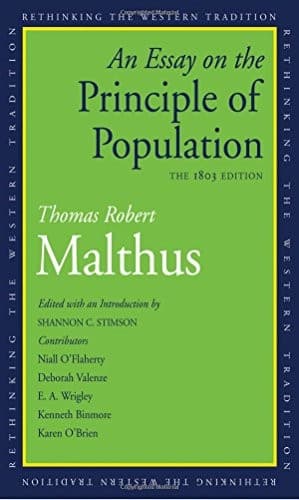
An Essay on the Principle of PopulationMalthus, T. R. (Thomas Robert)
Philosophy
An Essay on the Principle of Population
Malthus, T. R. (Thomas Robert)
Population
I am perfectly willing to concede to Mr Godwin that there is much more
labour in the world than is really necessary, and that, if the lower
classes of society could agree among themselves never to work more than
six or seven hours in the day, the commodities essential to human
happiness might still be produced in as great abundance as at present.
But it is almost impossible to conceive that such an agreement could be
adhered to. From the principle of population, some would necessarily be
more in want than others. Those that had large families would naturally
be desirous of exchanging two hours more of their labour for an ampler
quantity of subsistence. How are they to be prevented from making this
exchange? it would be a violation of the first and most sacred property
that a man possesses to attempt, by positive institutions, to interfere
with his command over his own labour.
Till Mr Godwin, therefore, can point out some practical plan according
to which the necessary labour in a society might be equitably divided,
his invectives against labour, if they were attended to, would
certainly produce much present evil without approximating us to that
state of cultivated equality to which he looks forward as his polar
star, and which, he seems to think, should at present be our guide in
determining the nature and tendency of human actions. A mariner guided
by such a polar star is in danger of shipwreck.
Perhaps there is no possible way in which wealth could in general be
employed so beneficially to a state, and particularly to the lower
orders of it, as by improving and rendering productive that land which
to a farmer would not answer the expense of cultivation. Had Mr Godwin
exerted his energetic eloquence in painting the superior worth and
usefulness of the character who employed the poor in this way, to him
who employed them in narrow luxuries, every enlightened man must have
applauded his efforts. The increasing demand for agricultural labour
must always tend to better the condition of the poor; and if the
accession of work be of this kind, so far is it from being true that
the poor would be obliged to work ten hours for the same price that
they before worked eight, that the very reverse would be the fact; and
a labourer might then support his wife and family as well by the labour
of six hours as he could before by the labour of eight.
Public-domain text, read in full here on John Shaqi.
Reviews
Reviews
No reviews yet
Be the first to share your thoughts on this work.
Elsewhere in the archive
Join the Discussion
Join the discussion
Sign in to leave a comment or review.
Sign InorCreate an account