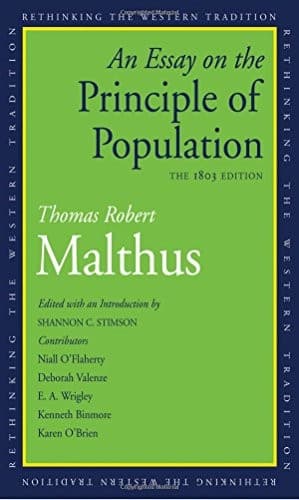
An Essay on the Principle of PopulationMalthus, T. R. (Thomas Robert)
Philosophy
An Essay on the Principle of Population
Malthus, T. R. (Thomas Robert)
Population
The commerce of this country, internal as well as external, has
certainly been rapidly advancing during the last century. The
exchangeable value in the market of Europe of the annual produce of its
land and labour has, without doubt, increased very considerably. But,
upon examination, it will be found that the increase has been chiefly
in the produce of labour and not in the produce of land, and therefore,
though the wealth of the nation has been advancing with a quick pace,
the effectual funds for the maintenance of labour have been increasing
very slowly, and the result is such as might be expected. The
increasing wealth of the nation has had little or no tendency to better
the condition of the labouring poor. They have not, I believe, a
greater command of the necessaries and conveniences of life, and a much
greater proportion of them than at the period of the Revolution is
employed in manufactures and crowded together in close and unwholesome
rooms.
Could we believe the statement of Dr Price that the population of
England has decreased since the Revolution, it would even appear that
the effectual funds for the maintenance of labour had been declining
during the progress of wealth in other respects. For I conceive that it
may be laid down as a general rule that if the effectual funds for the
maintenance of labour are increasing, that is, if the territory can
maintain as well as the stock employ a greater number of labourers,
this additional number will quickly spring up, even in spite of such
wars as Dr Price enumerates. And, consequently, if the population of
any country has been stationary, or declining, we may safely infer,
that, however it may have advanced in manufacturing wealth, its
effectual funds for the maintenance of labour cannot have increased.
It is difficult, however, to conceive that the population of England
has been declining since the Revolution, though every testimony concurs
to prove that its increase, if it has increased, has been very slow. In
the controversy which the question has occasioned, Dr Price undoubtedly
appears to be much more completely master of his subject, and to
possess more accurate information, than his opponents. Judging simply
from this controversy, I think one should say that Dr Price's point is
nearer being proved than Mr Howlett's. Truth, probably, lies between
the two statements, but this supposition makes the increase of
population since the Revolution to have been very slow in comparison
with the increase of wealth.
Public-domain text, read in full here on John Shaqi.
Reviews
Reviews
No reviews yet
Be the first to share your thoughts on this work.
Elsewhere in the archive
Join the Discussion
Join the discussion
Sign in to leave a comment or review.
Sign InorCreate an account