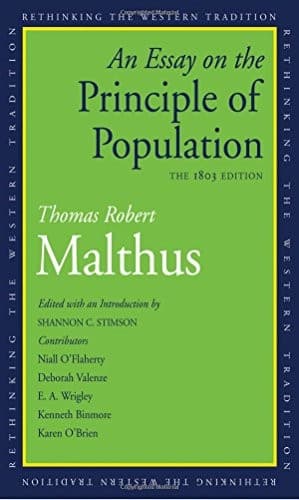
An Essay on the Principle of PopulationMalthus, T. R. (Thomas Robert)
Philosophy
An Essay on the Principle of Population
Malthus, T. R. (Thomas Robert)
Population
That the produce of the land has been decreasing, or even that it has
been absolutely stationary during the last century, few will be
disposed to believe. The enclosure of commons and waste lands certainly
tends to increase the food of the country, but it has been asserted
with confidence that the enclosure of common fields has frequently had
a contrary effect, and that large tracts of land which formerly
produced great quantities of corn, by being converted into pasture both
employ fewer hands and feed fewer mouths than before their enclosure.
It is, indeed, an acknowledged truth, that pasture land produces a
smaller quantity of human subsistence than corn land of the same
natural fertility, and could it be clearly ascertained that from the
increased demand for butchers' meat of the best quality, and its
increased price in consequence, a greater quantity of good land has
annually been employed in grazing, the diminution of human subsistence,
which this circumstance would occasion, might have counterbalanced the
advantages derived from the enclosure of waste lands, and the general
improvements in husbandry.
It scarcely need be remarked that the high price of butchers' meat at
present, and its low price formerly, were not caused by the scarcity in
the one case or the plenty in the other, but by the different expense
sustained at the different periods, in preparing cattle for the market.
It is, however, possible, that there might have been more cattle a
hundred years ago in the country than at present; but no doubt can be
entertained, that there is much more meat of a superior quality brought
to market at present than ever there was. When the price of butchers'
meat was very low, cattle were reared chiefly upon waste lands; and
except for some of the principal markets, were probably killed with but
little other fatting. The veal that is sold so cheap in some distant
counties at present bears little other resemblance than the name, to
that which is bought in London. Formerly, the price of butchers, meat
would not pay for rearing, and scarcely for feeding, cattle on land
that would answer in tillage; but the present price will not only pay
for fatting cattle on the very best land, but will even allow of the
rearing many, on land that would bear good crops of corn. The same
number of cattle, or even the same weight of cattle at the different
periods when killed, will have consumed (if I may be allowed the
expression) very different quantities of human substance. A fatted
beast may in some respects be considered, in the language of the French
economists, as an unproductive labourer: he has added nothing to the
value of the raw produce that he has consumed. The present system of
grating, undoubtedly tends more than the former system to diminish the
quantity of human subsistence in the country, in proportion to the
general fertility of the land.
Public-domain text, read in full here on John Shaqi.
Reviews
Reviews
No reviews yet
Be the first to share your thoughts on this work.
Elsewhere in the archive
Join the Discussion
Join the discussion
Sign in to leave a comment or review.
Sign InorCreate an account