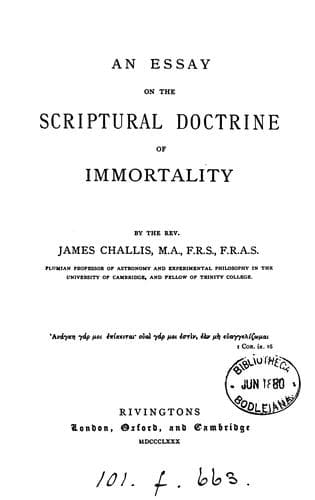
An Essay on the Scriptural Doctrine of ImmortalityChallis, James
Religion
An Essay on the Scriptural Doctrine of Immortality
Challis, James
Immortality
Testament, not, however, as signifying that the Old Testament is
superseded by the New, but that it reveals an earlier stage of
development of the same covenant.
The character and purpose of this covenant began to be unfolded at the
threshold of the world's history, on the occasion of offerings being
brought to God by Cain and Abel. Abel's offering consisted of "the
firstlings of his flock and the fat thereof," and was, therefore,
proper for expressing, by visible tokens, the character of the covenant
in three essential particulars: first, that it is a covenant of _life_,
the animals chosen affording _food_, and that of the choicest kind, for
supporting life; secondly, that the covenanted life is entered upon
after death, the animals being _slain_ {22} for food; thirdly, that
pain and death, although, according to law, consequent upon sin, were
ordained, not alone for the judicial punishment of sin, the animals
that were slain being "_harmless_," but for rendering the spirit of man
meet to partake of the future life. Abel was himself in his death the
first witness (_martus_) to this truth, and by the same means many
chosen servants of God have been "purified and made white" (Dan. xii.
10). The offering of Cain was also proper for food, but as consisting
of "fruits of the ground," it was not, like Abel's, susceptible of any
meaning relative to the covenant. Grace was given to Abel to select an
offering which, as being significant of the covenant, was accepted by
God; but the same grace was not given to Cain. "The Lord had respect
to Abel and to his offering: but to Cain and to his offering He had not
respect."
The narrative goes on to say that because the Lord had not the same
respect to Cain's offering as to Abel's, Cain was "very wroth, and his
countenance fell," and that on this account he was rebuked. It should
be noticed that the terms of the rebuke have no reference to the choice
of offering, but to "doing well," implying that Cain's conduct was not
"righteous" like that of Abel. To quiet his troubled spirit, he is
told that it is God's pleasure that he should stand towards his brother
in the relation of protector and ruler. Cain repudiated this relation
{23} and slew his brother, acting thus as the unrighteous world, of
whom he may be regarded as the representative, have always acted
towards God's elect, whom Abel typified. These remarks will afterwards
be seen to bear on the general argument.
Public-domain text, read in full here on John Shaqi.
Reviews
Reviews
No reviews yet
Be the first to share your thoughts on this work.
Join the Discussion
Join the discussion
Sign in to leave a comment or review.
Sign InorCreate an account