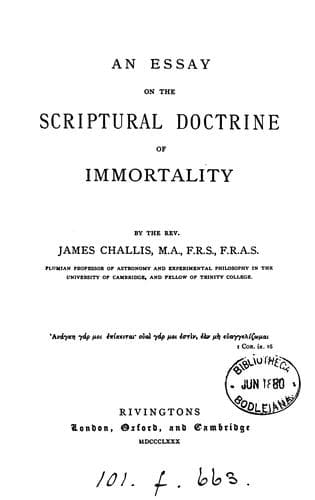
An Essay on the Scriptural Doctrine of ImmortalityChallis, James
Religion
An Essay on the Scriptural Doctrine of Immortality
Challis, James
Immortality
There are other considerations relating to the future judgment which it
is necessary to enter into in order to complete the argument for the
immortality of all men. We live in a world in which sorrow and pain
and death abound everywhere and at all times, and although these are
actual consequences of sin, inasmuch as they would be non-existent if
sin did not antecedently exist, it is not the less true that the _law_
which in the present time of imperfection connects suffering with sin,
tends in its operation towards bringing on eventually a state of
perfection. Thus there is a final cause for that law. I have already
(page 14) illustrated this doctrine by reference to the process whereby
the actual condition and adornment of this earth were elaborated by the
operation of physical laws out of a state of darkness and chaos. This
view is corroborated by the noticeable fact that suffering in this
life, whether caused by the three scourges, war, pestilence, and
famine, or what we call accident, or by the injustice and cruelty of
men, by no means in proportion to guilt, since even the innocent
thereby sometimes suffer. Now, as all {50} human deeds and experience
are taken cognizance of in the great day of judgment, it must be
admitted that sufferings of the kind just mentioned will be included in
the account. In what way, and with what effect, will, I think, be to
some extent indicated by the following considerations.
Besides the principle of animal life (_psyche_) which man partakes of
in common with the creatures of a lower order, there is within him a
spirit (_pneuma_) which is being formed, educated, and built up, all
the time that it is the tenant of a corporeal "vessel." On account of
this law of progressiveness, the spirit of a child, as we can all see,
differs in its feelings and its understanding from that of a man. In
short, spirit perfected is the principle of immortal life. Now, during
our waking hours our spirits are replete with consciousness and
thought, which, however, at the moment of falling asleep depart from
us. The spirit is then taken into the keeping of the angels of God, to
be by them restored into its place in the body at the moment of waking
up and of return to consciousness. In like manner at death the spirits
of all men, good and wicked, pass into the custody of the Creator of
spirits, to wait for the return to consciousness by being on the
morning of their resurrection again united with body,--not, however,
with the same natural body, but with a spiritual body (1 Cor. xv. 44).
The union of spirit with bodily essence appears to be a {51} necessary
condition of human consciousness, and to have been ordained for the
special reasons that we are destined to live hereafter not only
individually, but in _social_ relations also, and that only through the
medium of body is there communion between one man's spirit and that of
another.
Public-domain text, read in full here on John Shaqi.
Reviews
Reviews
No reviews yet
Be the first to share your thoughts on this work.
Join the Discussion
Join the discussion
Sign in to leave a comment or review.
Sign InorCreate an account