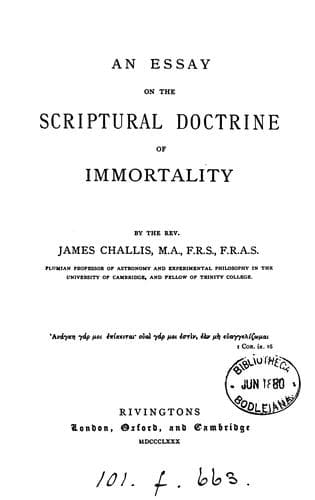
An Essay on the Scriptural Doctrine of ImmortalityChallis, James
Religion
An Essay on the Scriptural Doctrine of Immortality
Challis, James
Immortality
Again, in proof of the doctrine that the process, or effect, of the
general judgment is characterized in Scripture as "slaughter," Isa.
xxxiv. 1-6 may be cited, it being said in that passage that "the
indignation of the Lord is upon all nations," that "he hath delivered
them to the slaughter," and in connection therewith that "all the host
of heaven shall be dissolved, and the heaven shall be rolled together
as a scroll" (compare Rev. vi. 18-14). Of the same import is the
prophecy in Rev. xiv. 14-20, at the end of which the treading of "the
great winepress of the wrath of God" is described in terms closely
agreeing with those in Isa. lxiii. 1-4. We have, besides, the
remarkable passage, Rev. xix. 17-21, which represents the fowls of
heaven as being called together to feast on the flesh of the slain,
after great slaughter had been wrought by "the sharp sword" which
proceeds out of the mouth of him who is called "The Word of God." This
sword represents the cutting and destructive effect of the words of
judgment and condemnation which the Son of God will pronounce on
sinners when he comes to judge the whole world. It is not necessary
for my purpose to interpret particularly the symbolism {57} contained
in the passages just quoted; it suffices to draw from them the general
inference that, as regards _all_ men, trouble and pain and death in the
present age of the world are the beginnings of an [oe]conomy for
forming spirits for immortality, which is destined to be consummated in
the age to come.
To complete the argument from Scripture it only remains now to take
into consideration those passages which expressly reveal the effect of
the general judgment, and to ascertain what relation the revelations
have to the question of immortality. These passages are of two kinds,
some being composed entirely of symbolic language requiring
interpretation, while others are expressed in terms that may be readily
understood. The former must be supposed to admit of being interpreted
consistently with the plain meaning of the other kind. Accordingly,
for the purpose above mentioned, I proceed now to offer an
interpretation of Rev. xx. 11-15, this passage evidently giving a
synoptical account, in symbolic terms, of the process and the effect of
the general judgment.
Public-domain text, read in full here on John Shaqi.
Reviews
Reviews
No reviews yet
Be the first to share your thoughts on this work.
Join the Discussion
Join the discussion
Sign in to leave a comment or review.
Sign InorCreate an account