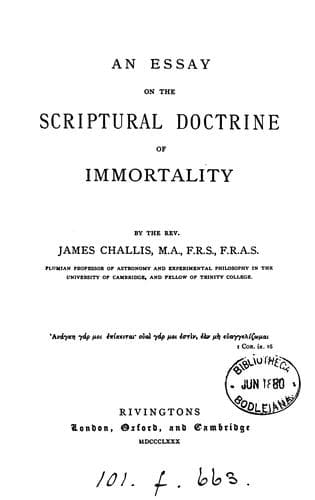
An Essay on the Scriptural Doctrine of ImmortalityChallis, James
Religion
An Essay on the Scriptural Doctrine of Immortality
Challis, James
Immortality
There exists, moreover, in the present day so long-standing and so
general an inability to discern the inner and true sense of Scripture,
"the letter which killeth" having been preferred to "the spirit which
maketh alive," that it has become a matter of much difficulty to
comprehend and explain the terms in which the gospel in its entirety is
therein proclaimed, and either to give, or to receive, instruction
which may conduce to an intelligent acceptance of it. {124} In
addition to which there prevails a tendency to rely on traditional and
formal doctrine, and to assign to it an authority co-ordinate with that
of Scripture, although as having had its origin at times when primitive
faith and knowledge had in great measure declined, and "the mystery of
iniquity" was already working, it cannot but be mixed with a human
element of untruth. This tendency, which appears to be attributable to
a consciousness of inability to form an independent judgment of the
truths of Scripture, operates at present in creating a prejudice
against all attempts to go beyond the boundaries by which Scriptural
knowledge is assumed to be circumscribed. Nevertheless, regarding it
as a duty to employ the opportunities and the ability which God has
given me in making such an attempt, I have endeavoured to place the
doctrine of the salvation and immortality of all men on a Scriptural
basis, and I have now only to ask for an unprejudiced consideration of
the arguments I have adduced for that purpose.
[1] See the notes to Rom. v. 12-20, given in pp. 36-38 of my
"Translation of St. Paul's Epistle to the Romans" (Cambridge: Deighton
and Co, 1871).
[2] The treatise referred to is entitled "De Fatura, Bestauratione,"
and the passage cited is very near the end of it. This treatise is an
appendix to another, the title of which is "De Statu Mortuorum et
Resurgentium."
[3] So far this explanation of Mark ix. 44 is the same as that which I
have given in a letter to the editor of the _Clerical Journal_, which
is inserted in the number for June 5, 1862 (p. 526).
{125}
APPENDIX.
I have allowed to stand in the Essay (pp. 76-81) the views I held at
the time it was composed respecting the interpretation of Matt. xxv.
46, because I considered that these views, although in certain respects
they are inconsistent with those I maintain in this Appendix, might
contribute, by comparison with the latter, towards an understanding of
the passage. The interpretation which, after long consideration, I
have finally adopted, was first published in two letters, contained
under the head of "Correspondence," in the numbers of the _Guardian_
for December 27, 1877, and January 16, 1878. With the view of offering
some additional arguments in support of that interpretation, and making
it more generally intelligible, I propose to begin with producing _in
extenso_ the two letters referred to.
"ETERNAL PUNISHMENT.
"Sir,
Public-domain text, read in full here on John Shaqi.
Reviews
Reviews
No reviews yet
Be the first to share your thoughts on this work.
Elsewhere in the archive
Join the Discussion
Join the discussion
Sign in to leave a comment or review.
Sign InorCreate an account