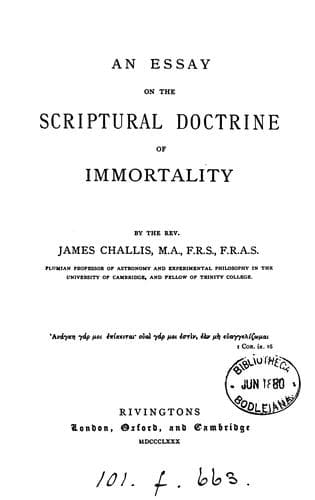
An Essay on the Scriptural Doctrine of ImmortalityChallis, James
Religion
An Essay on the Scriptural Doctrine of Immortality
Challis, James
Immortality
"After reading attentively the letters of your correspondents to which
the sermon of Dr. Farrar has given occasion, it appeared to me that
some views in addition to those which have hitherto been proposed, and
in certain respects controverting them, may be worthy of consideration.
I beg, {126} therefore, to be allowed space for making the following
remarks:--
"We are taught in the Scriptures that hereafter there will be a new
constitution of the universe, 'new heavens and a new earth wherein
dwelleth righteousness' (2 Peter iii. 13), and that in this perfect
social state 'there shall be no more death, neither sorrow, nor crying,
neither shall there be any more pain' (Rev. xxi. 4). To reconcile this
revelation, so intelligible and so comprehensive, with the meaning of
passages which seem to say that the punishment of the wicked will be
'endless,' presents a very great difficulty. We are not at liberty in
such cases to accept some parts of Scripture and reject others in order
to get rid of the difficulty, but must believe that the truth, if it
should be reached, will establish the consistency of all, and that
seeming contradictions are only due to our ignorance. I propose for
consideration the following solution of the above-stated difficulty:--
"Jesus Christ in his ministration on earth said, in the course of
giving instruction to his _disciples_ (Matt. xxiv. 3), 'These [on the
left hand] shall go into eternal punishment, and the righteous into
eternal life' (Matt. xxv. 46). Considering that in all he said and did
he had in view his Father's purpose of making the spirits of men meet
for immortality, it may be asked, In what way was such teaching
contributory to this end? May we not conclude from our Lord's words,
apart from all other inferences, that eternal life is necessarily
preceded by righteousness, and eternal punishment is as necessarily
consequent upon sin, and that the knowledge of these divine decrees
contributes to the formation of spirits for the life to come? This
inference might be accepted as abstractedly true; but then the question
arises, What is meant by _duration_ as signified by the word 'eternal'?
It should be remarked that in the statement of the doctrine I have
employed the word 'necessarily' in a sense that is not unusual, and is
generally thought to be intelligible. But it is to be taken into
account that no such use of the term occurs in Scripture, where, in
fact, it would be wholly {127} incongruous. The reason of this is that
the Scriptures contain no abstract truths which are not expressed, or
expressible, in terms understood from the facts and conditions of human
experience. This may especially be said of the discourses of our Lord,
in consequence of which they are much misunderstood by the many who are
incapable of discerning the spiritual through the literal, who, as he
said, 'have eyes and see not, and ears and hear not.' Assuming,
Public-domain text, read in full here on John Shaqi.
Reviews
Reviews
No reviews yet
Be the first to share your thoughts on this work.
Elsewhere in the archive
Join the Discussion
Join the discussion
Sign in to leave a comment or review.
Sign InorCreate an account