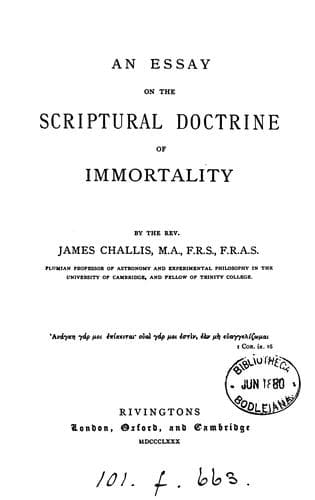
An Essay on the Scriptural Doctrine of ImmortalityChallis, James
Religion
An Essay on the Scriptural Doctrine of Immortality
Challis, James
Immortality
"After the publication of my letter in the _Guardian_ of December 27
(p. 1786), I received from various quarters interrogations and
arguments, which led me to see that there was an omission in one part
of my reasoning, by supplying which the whole of the argument might be
made much more complete. In particular, it was maintained by my
correspondents, I admit quite logically, that if eternal punishment in
Matt. xxv. 4:6 could be taken to mean punishment which has an end, by
parity of reasoning 'eternal life' must there mean life which has an
end. As I find that the same argument has been adduced in the
correspondence of the _Guardian_, I hope I may {130} be allowed,
notwithstanding the length to which the discussion of the subject has
gone, the opportunity of a supplementary letter for showing how, by
rectifying the above-mentioned defect, the views I have proposed meet
this difficulty.
"In the Scriptures definite mention is made of only two ages, the
present age and the future age, or, in other words, 'this world and the
world to come' (Matt. xii. 32). The plural ages (_aiones_) and 'ages
of ages' are expressions to which we can by no mental effort attach a
definite signification, and consequently, as I endeavoured to show in
my former letter, they admit of various abstract applications. As in
the present age, so in the age to come, there is a _succession_ of
events which take place under conditions of time. These events have
received comparatively but small attention in the theology of the
present day, apparently because it is not generally seen that they are
spoken of much more largely by the prophets of the Old Testament than
in the New Testament, in which it is assumed that the old prophets are
understood; and again, because the epitome given in the Book of
Revelation (see Rev. x. 7) of the communications vouchsafed to the
prophets is expressed in symbols which we find it hard to interpret.
There are, however, passages in the New Testament which expressly make
known the relation of deeds and events of the present age to those of
the age to come; as especially our Lord's discourse 'as he sat on the
Mount of Olives,' and the apostles 'Peter and James and John and
Andrew' asked Him privately to tell them what would be the sign of his
coming, and of _the end of the world_ (_tes synteleias tou aionos_).
There is also that remarkable passage in which St. Matthew records that
Jesus said to Peter, 'Ye who have followed me, in the regeneration when
the Son of man shall sit on the throne of his glory, ye also shall sit
on twelve thrones, judging the twelve tribes of Israel.' The number
'twelve' in Scripture symbolism always signifies 'election;' the judges
may be presumed to be of the order of prophets and apostles--the elect
of the elect--and the twelve tribes of Israel the whole number of the
elect (see Rev. vii. 4-8). Now, these {131} twelve times twelve
thousand, symbolizing the complete number of the redeemed of every age
Public-domain text, read in full here on John Shaqi.
Reviews
Reviews
No reviews yet
Be the first to share your thoughts on this work.
Elsewhere in the archive
Join the Discussion
Join the discussion
Sign in to leave a comment or review.
Sign InorCreate an account