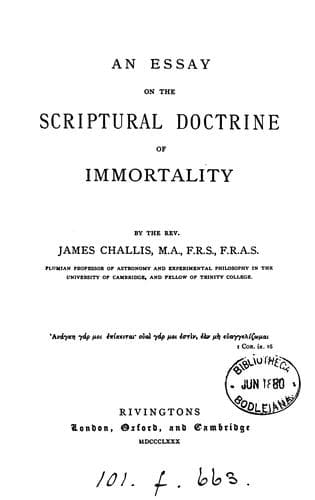
An Essay on the Scriptural Doctrine of ImmortalityChallis, James
Religion
An Essay on the Scriptural Doctrine of Immortality
Challis, James
Immortality
and nation, are 'the firstfruits unto God and to the Lamb,' and being
made perfect by suffering and judgment, farther on in the events of
that age 'follow the Lamb whithersoever he goeth,' and together with
him execute the final judgment on the whole world (Rev. xix. 14),
inclusive even of the judgment on Satan and his angels. This doctrine
seems to have been generally taught in the days of the apostles,
inasmuch as St. Paul writes to the Corinthians (1 Epist. vi. 2, 3),
'Know ye not that the saints shall judge the world?' 'Know ye not that
we shall judge angels?' Even in the Psalms we read, 'This honour have
all His saints' (see Psalm cxlix. 6-9).
"On these premises, it seems to me, the following argument may be
founded relative to the interpretation of Matt. xxv. 46. In that
chapter the _separation_ between the sheep and the goats is spoken of
as initiatory to the general judgment, and the chapter closes with an
exposition of the principles on which the judgment is conducted as
regards both the one class and the other. The details and the
processes of the judgment, together with its _results_, are to be
sought for in the writings of the prophets and in the Book of
Revelation. Now, when account is taken of all events of that future
life, it may be said, I think, with truth, that the righteous who live
and act in it throughout, when that life begins enter into 'eternal
life,' the word 'eternal' being applicable because that age has a
time-limit. _This_ eternal life, the mention of which was omitted in
the former letter, merges into endless, or indissoluble, life, when
time is no more, and words expressive of time cease to have
application. In an analogous manner the unrighteous may be said to go
into 'eternal punishment' when they enter upon the experience of the
future age, the limit of the effects of the judgment and punishment
which they are doomed to undergo being a 'second death.' However great
and terrible may be the woe and tribulation attendant on that event, we
know as matter of experience of life at present, that death, of itself,
is but a passage into another state of existence. We have, {132}
therefore, no right to affirm that after the effects of judgment and
punishment are accomplished, the second death is not a transition into
that state of things in the new heavens and new earth which is
described in Rev. xxi. Rather, may we not conclude that eternal life
and eternal punishment terminate alike with the end of time, and that
in the consummation of all things both are merged in indissoluble life,
that God may be all in all? This conclusion appears to meet the
difficulty stated at the beginning of this letter.
Public-domain text, read in full here on John Shaqi.
Reviews
Reviews
No reviews yet
Be the first to share your thoughts on this work.
Elsewhere in the archive
Join the Discussion
Join the discussion
Sign in to leave a comment or review.
Sign InorCreate an account