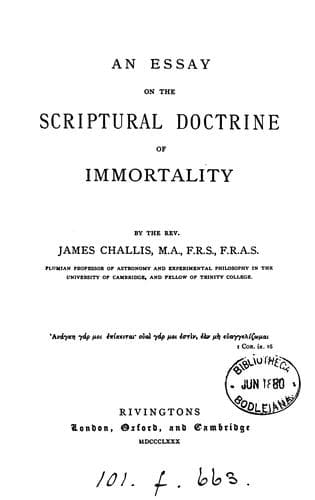
An Essay on the Scriptural Doctrine of ImmortalityChallis, James
Religion
An Essay on the Scriptural Doctrine of Immortality
Challis, James
Immortality
On reconsidering the arguments of the Essay it occurred to me that it
would be proper to take notice in the Appendix of one other subject.
In pages 9, 15, and 63 the doctrine that immortality is dependent on a
state of perfected righteousness is regarded as "self-evident." I
{135} now think that the use of that term is objectionable, inasmuch
as, according to the title of the Essay, every such statement ought to
rest wholly on Scriptural ground. I propose, therefore, to adduce here
passages of Scripture which indicate an intimate relation between
righteousness and life. Out of many texts which might be cited for
this purpose, I have selected two, as follows. First, when under the
law, Moses said to the Israelites, "I have set before you life and
death: choose life," they must have understood his words as signifying
that on condition of submission to the will of God and obedience to His
righteous laws, they might look forward in faith to the enjoyment of
the future covenanted life. (See what is said on this text in p. 28.)
Again, the same dependence of life on righteousness forms an essential
part of the Gospel of Jesus Christ, although taught in a different
manner. St. Paul, for instance, has given in Rom. v. 18, the following
summary of Christian doctrine. Therefore as through one transgression
(__di henos paraptomatos_), unto all men, unto condemnation (_eis
katakrima_), so through one righteousness (_di henos dikaiomatos_, i.e.
the obedience unto death of Jesus Christ), unto all men, unto
life-justification (_eis dikaiosin zoes_), where, it should be noticed,
_zoes_ is not a dependent genitive, but, as in many instances in New
Testament Greek, a genitive of quality. Thus this text declares that
the justification of all men, which is their being eventually made
righteous through the operation of the Son of God, has the quality of
conferring _life_.
Transcriber's notes:
This book contains many fragments of Greek, so many that the convention
of using "[Greek:...] to indicate transliterated Greek passages was
abandoned in favor of using underscores to indicate Greek material.
Transliteration was done according to the Project Gutenberg Greek
How-To guidelines.
Underscores are also used to indicate italicized words, but in all
cases such words are English words.
The sequence "[oe]" is used to indicate the Unicode oe-ligature
character.
Public-domain text, read in full here on John Shaqi.
Reviews
Reviews
No reviews yet
Be the first to share your thoughts on this work.
Elsewhere in the archive
Join the Discussion
Join the discussion
Sign in to leave a comment or review.
Sign InorCreate an account