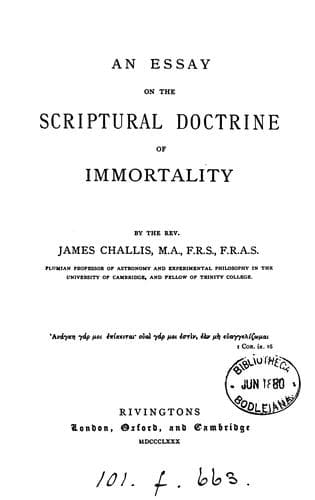
An Essay on the Scriptural Doctrine of ImmortalityChallis, James
Religion
An Essay on the Scriptural Doctrine of Immortality
Challis, James
Immortality
That the words of the passage in St. Matthew might be understood, at
least by the disciples to whom they were addressed, in the sense above
indicated, may be inferred from the knowledge of the religious Jews of
that time respecting the events of the future age, as conveyed to them
by the writings of the prophets of the Old Testament, with which they
were familiar. In proof of the general diffusion of such knowledge we
may cite the response of Martha to the Lord respecting the resurrection
of Lazarus, "I know that he shall rise again at the resurrection in the
last day" (John xi. 24), and the common belief of a resurrection of the
dead entertained by the numerous sect of the Pharisees, as well as the
particular character of the unbelief of the smaller body of Sadducees
(see Acts {134} xxiii. 8, where it is stated that "the Sadducees say
that there is no resurrection, neither angel, nor spirit: but the
Pharisees confess both"). It is hard to perceive etymologically how
the word _aiouios_ could have received the meaning "ever-_lasting_."
There is, in fact, a very remarkable passage of the Apocalypse in which
that meaning is quite excluded: "And I saw another angel fly in the
midst of heaven, having the gospel of the age to come to preach
(_euaggelion aionion euaggelisai_) unto them that dwell on the earth,
and to every nation, and kindred, and tongue, and people, saying with a
loud voice, Fear God, and give glory to Him; for the hour of His
judgment is come: and worship Him that made heaven, and earth, and the
sea, and the fountains of waters" (Rev. xiv. 6, 7). It is evident that
if _aionion euaggelion_ here meant an everlasting gospel, the event
which the good news is intended to announce would never come. It may,
perhaps, be asserted that this passage of the Apocalypse refers to a
gospel announcement taking place at the present time, considering that
a distinctive feature of this age is a large increase of the knowledge
of the facts and laws of nature, and that possibly, contemporaneously
with such knowledge, God may vouchsafe a fuller understanding of the
Book of Revelation, and a discernment of the [oe]onian gospel it
proclaims (compare Dan. xii. 3, 4). That the true interpretation of
the Apocalypse will eventually be reached is implied by the words,
"Seal not the sayings of the prophecy of this book" (Rev. xxii. 10).
Public-domain text, read in full here on John Shaqi.
Reviews
Reviews
No reviews yet
Be the first to share your thoughts on this work.
Elsewhere in the archive
Join the Discussion
Join the discussion
Sign in to leave a comment or review.
Sign InorCreate an account