Scanner's Note: I have made two changes in this text. First I have
removed the footnotes to the end of each chapter and I have placed
note 9 at the end of chapter 6 noting that because of the ratification
of the XIX amendment to the Constitution for the United States,
August 20, 1920, women were fully enfranchised with all rights of
voting and jury service in all states of the Union. Other than the lack
of italics and bold in this text and the typos (may they be few) this is
the complete first edition text. Let me know of any mistakes you have
caught! My email address's for now is haradda@aol.com and
davidr@inconnect.com.
David Reed
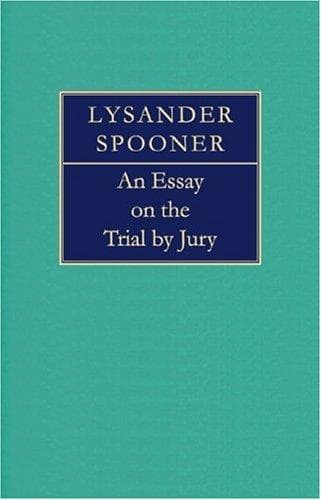
An Essay on the Trial By Jury
By LYSANDER SPOONER
Entered according to Act of Congress, in the year 1852, by
LYSANDER SPOONER
In the Clerk's Office of the District Court of Massachusetts.
NOTICE TO ENGLISH PUBLISHERS
The author claims the copyright of this book in England, on
Common Law principles, without regard to acts of parliament; and
if the main principle of the book itself be true, viz., that no
legislation, in conflict with the Common Law, is of any validity,
his claim is a legal one. He forbids any one to reprint the book
without his consent.
Stereotyped by HOBART & ROBBINS;
New England Type and Stereotype Foundery,BOSTON.
NOTE
This volume, it is presumed by the author, gives what will
generally be considered satisfactory evidence, though not all the
evidence, of what the Common Law trial by jury really is. In a
future volume, if it should be called for, it is designed to
corroborate the grounds taken in this; give a concise view of the
English constitution; show the unconstitutional character of the
existing government in England, and the unconstitutional means
by which the trial by jury has been broken down in practice; prove
that, neither in England nor the United States, have legislatures
ever been invested by the people with any authority to impair the
powers, change the oaths, or (with few exceptions) abridge the
jurisdiction, of juries, or select jurors on any other than Common
Law principles; and, consequently, that, in both countries,
legislation is still constitutionally subordinate to the discretion and
consciences of Common Law juries, in all cases, both civil and
criminal, in which juries sit. The same volume will probably also
discuss several political and legal questions, which will naturally
assume importance if the trial by jury should be reestablished.
CONTENTS
CHAPTER I. THE RIGHT OF JURIES TO JUDGE OF THE
JUSTICE OF LAWS
SECTION 1.
SECTION 2.
CHAPTER II. THE TRIAL BY JURY, AS DEFINED BY
MAGNA CARTA
SECTION 1. The History Of Magna Carta
SECTION 2. The Language Of Magna Carta
Public-domain text, read in full here on John Shaqi.
Reviews
Reviews
No reviews yet
Be the first to share your thoughts on this work.
Join the Discussion
Join the discussion
Sign in to leave a comment or review.
Sign InorCreate an account