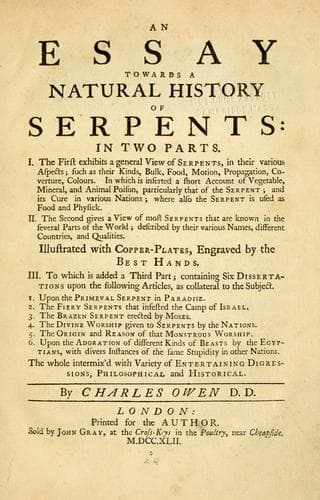
An essay towards a natural history of serpentsOwen, Charles
History
An essay towards a natural history of serpents
Owen, Charles
Serpent worship -- Early works to 1800; Serpents -- Early works to 1800; Serpents -- Religious aspects -- Early works to 1800
LXV. The _Anacandia_, a _Ceylonick_ Serpent, of monstrous Corpulence,
being in longitude about 25 Foot. _D. Cleyerus_, who accounts for this
gigantick Serpent, says, he saw one of them open’d, in whose Belly was
found a whole Stag, with all his integral Parts: In another they found a
wild Goat; and in a third, a Porcupine arm’d with all its Darts and
Prickles[237]. Serpents of this nature have often fallen in our way, by
which we may imagine, that there is a vast spread of them over the
Earth. Mr. _Ray_ from _Cleyerus_ gives this account of the Monster——Tho’
the Throat seems narrow, yet ’tis very extensible, and the Facts have
been confirm’d by Experience. When the Prey is catch’d, he wraps himself
about it, takes it by the Nose, sucks the Blood, and soon reduces it to
a Hodge-podge; after he has broken the Bones in pieces, that emit a
Sound like a Gun, _ibid._ And in doing all this he spends two days.
Footnote 237:
_De octavo genere merentur legi, quæ D. Cleyerus in Ephemer. German._
Anno 12. Observ. 7. cui titulas, _De Serpente magno Indiæ Orientalis.
Urobubalum deglutiente Narrat. Raii Synopsis Animalium_,—p. 333, 334.
LXVI. The _Ghalghulawa_ is another _Ceylonite_, that goes by the Name of
_Serpens Indicus Saxatilis_, describ’d by whitish Lines, that run across
one another: Whether the Poet refers to this, as a Serpent affecting
stony and gravelly Situations, or to a certain Fish, I determine
not[238].
Footnote 238:
Tum viridis squamis, parvo saxatilis ore. _Ovid._
LXVII. The _Manballa_ is another _Indian_, and from its Name we may
conclude it has something of the canine Nature, for it flies with great
Fury at Passengers, as some Dogs usually do. ’Tis of a light red (or
bright bay, as we call it in Horses) spotted with white.
LXVIII. The _Nintipolonga_, an _Indian_ Serpent, whose Skin is checker’d
with white and black Spots. Its Bite is accompanied with mortiferous
Sleep, therefore call’d _Serpens hypnoticus_, _soporiferous Serpent_,
whose Wounds are as an _Opiate_, or _Medicines_ that induce sleep, in
which they die. _Q._ Why may not we suppose this narcotic Poison to be
the same with that, which _Cleopatra_ used in executing the Sentence
that _Heroine_ past upon herself?
LXIX. The _Wepelon_ Serpent: Nothing is said of it, but that it
resembles an _Indian_ Reed or Cane in form.
LXX. _SERPENS Fluviatilis_, seems to be the _Water-Snake_.
LXXI. _SERPENS Spadiceus_, a Serpent of light red Colour.
LXXII. Then follows the _Ceylonic Hotambœia_. Dr. _Robinson_’s Account
of this Serpent, he had from the learned _Hermannus_’s Library.
_N. B._ Some of these Eastern Serpents may coincide and agree in
Character with those in _America_, and other Regions. Where there is
such an infinite Variety of them, and delineated by so many different
hands, ’tis difficult to give an exact Description of every individual
Serpent.
Public-domain text, read in full here on John Shaqi.
Reviews
Reviews
No reviews yet
Be the first to share your thoughts on this work.
Elsewhere in the archive
Join the Discussion
Join the discussion
Sign in to leave a comment or review.
Sign InorCreate an account