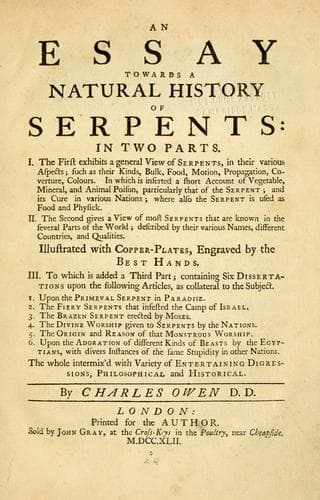
An essay towards a natural history of serpentsOwen, Charles
History
An essay towards a natural history of serpents
Owen, Charles
Serpent worship -- Early works to 1800; Serpents -- Early works to 1800; Serpents -- Religious aspects -- Early works to 1800
Other parts of the _East-Indies_ (Continent and Islands) are infested
with Serpents of various kinds and sizes, and he must be more than a
Conjurer in History, that can charm them to make their Appearance in one
Place, and all in their proper Habiliments.
LXXIII. The _hooded_ or _Monk Serpent_, found in an Island near
_Batavia_ (a _Dutch_ Settlement in the _East-Indies_) which differs from
other Serpents in the _uncouth Shape of its Head_, that looks as if it
were cover’d with a large long _Hood_, like a _Monk’s Cowl_, or the
Widow’s Veil, therefore called the _hooded Serpent_, which is a very
dangerous Animal. Upon a view of its Prey, it immediately advances
towards it, with terrible Rage and Hissing.
When the _Sieur de la Case_ was hunting one day in the Woods adjacent to
_Batavia_, he saw one of these Serpents descending from a Tree, making a
fearful Noise: It was about the thickness of a Man’s Arm, and in length
about eight Foot.
This venemous Creature was no sooner on the Ground, but it made towards
him with the greatest Fury; but having a Gun ready charg’d, he very
happily shot it dead, and made off hastily for fear of a second
Attack[239].
Footnote 239:
_Fr. Leguat_’s _Voyages_, in _Atl._ for _Asia_.
_LEGUAT_, who gives this Account, and was in _Batavia_, _A.D._ 1697,
says, he saw a Serpent in that Country about fifty Foot long. _N. B._
The Skin of one that was 20 Foot long, is shewn in _Batavia_, that
swallow’d an Infant, _ibid._
LXXIV. The _Musk Serpent_, so term’d from its musky or sweet Scent.
These sweet-scented Animals are Inhabitants of the _East_, between
_Calicut_, the second Kingdom of _Malabar_, and _Candahor_. In _Ceylon_
are Musk-Rats, where the Inhabitants eat all Rats, but this kind.
These Musk-Rats are in all things shaped like our Water-Rats, only
something larger; and in other respects differ only in that musky Scent.
A Gentleman, who kept one of them in a wooden Chest, observed that two
days before it died, ’twas most odoriferous, and scented the Room above
what was common[240]. In _Muscovy_ is a Water-Rat, which smells like
Musk; and also a great number of _Musk-Cats_, which look like young
_Bucks_ without Horns, and therefore call’d _Musk-Harts_ by the
_Chinese_, because they resemble those Creatures. The Musk is contain’d
in a little Excrescence near the Navel[241].
Footnote 240:
_Lowthorp_’s _Abridg._ vol. iii. p. 594.
Footnote 241:
This Animal is described by _Philip Martinus_ in his _Chinese Atlas_.
In _America_ also, are found Woods abounding with Musk-Rats, that are as
big as Rabbits, and have Burrows in the Ground. Their Skins are black,
Bellies white, and smell exceeding strong of Musk[242]. The vegetable
World also, entertains us with Musk-Pears, Musk-Roses, single and
double, and the Ever-green, _&c._ _N. B._ Musk-Rats frequent fresh
Streams, and no other.
Footnote 242:
_History of the Antilles._
Public-domain text, read in full here on John Shaqi.
Reviews
Reviews
No reviews yet
Be the first to share your thoughts on this work.
Elsewhere in the archive
Join the Discussion
Join the discussion
Sign in to leave a comment or review.
Sign InorCreate an account