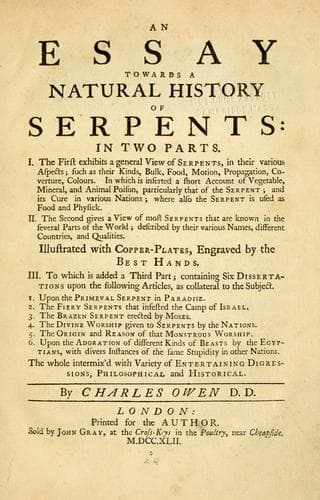
An essay towards a natural history of serpentsOwen, Charles
History
An essay towards a natural history of serpents
Owen, Charles
Serpent worship -- Early works to 1800; Serpents -- Early works to 1800; Serpents -- Religious aspects -- Early works to 1800
This puts me in mind of _Hippocrates_, the Prince of Physicians, who
tells us that in the Eastern Parts of _Europe_, there is a _Scythian
People_, called _Sauromatæ_, bordering on the _Palus Mæotis_, where the
Women ride on Horse-back, draw the Bow, throw the Javelin as they ride,
and fight in their Battles, so long as they remain Virgins; and were not
allow’d to marry, _till they had killed three Enemies in the Wars_[268].
Of my Author ’tis said, He neither knew how to _deceive_, nor be
_deceived_[269].
Footnote 268:
_Hippocrates upon Air, Water, and Situation; upon Epidemical
Diseases_, _&c._ translated into _English_, by the learned Dr.
_Clifton_.
Footnote 269:
Of _Hippocrates_ ’tis said,——_Qui tam fallere quam falli nescit_.
-Macrobii Opera, p. 27.
_N. B._ These were the Women called _Amazons_, descended from the
_Scythians_, whose Women were as warlike as the Men, and joined with
them in their Wars.
CIII. The _Corn-Snake_, is most like the _Rattle-Snake_ of all others in
Colour, but the Chequers are not so regular; neither has it any Rattles.
They are frequently found in _Corn-fields_, from whence, I presume, they
have their Appellation. In their Qualities they resemble the
_Green-Snakes_, that are innocent by Nature, and in form admirably
pretty, if I may be allow’d by the Ladies, to call a Serpent so.
CIV. The _Blowing-Serpent_, which is a Species of the Viper, but larger
than the _European_, is so called, because it seems to blow, to spread
its Head, and swell very much, before it bites; which Bite is very
poisonous, and seems to receive some additional Malignity from the
Enlargement of its Head beyond the common Proportion.
CV. The _Brimstone-Snake_, so denominated from the Similitude of Colour:
They might as well call it, the _Glass-Snake_, for if any Credit be
given to the Historian, ’tis as brittle as a Glass-Tube, or a
Tobacco-Pipe, so that upon the touch of a Twig, it immediately breaks
into several Pieces, which some say, and nobody believes, are capable of
Re-union.
Its component Parts may be weak and frail, but it is questionable,
whether so brittle as represented: ’Tis true indeed there are hard
Bodies, that would not be affected with a Twig, yet are very brittle.
Thus _Iron_, which is one of the hardest Metals and yet _most brittle_,
and by fusing, it becomes harder and more brittle. Now this great
Brittleness of Iron, arises from the great quantity of Sulphur-Brimstone
intermixed with it. The abundance of _Sulphur_ in _Iron_, is apparent
from the _Sparks_ it emits from under the Smith’s Hammer; those fiery
Sparks being only the Sulphur of the heated Iron, nothing of which is
seen in any other Metal[270]. _N. B._ Roll-Brimstone sold in the Shops
comes from the native Sulphur, which _Helmont_ always preferred to that
purified.
Footnote 270:
_Boerhaave’s Method of Chemistry._
Public-domain text, read in full here on John Shaqi.
Reviews
Reviews
No reviews yet
Be the first to share your thoughts on this work.
Elsewhere in the archive
Join the Discussion
Join the discussion
Sign in to leave a comment or review.
Sign InorCreate an account