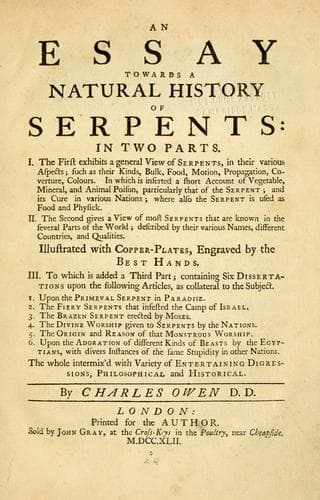
An essay towards a natural history of serpentsOwen, Charles
History
An essay towards a natural history of serpents
Owen, Charles
Serpent worship -- Early works to 1800; Serpents -- Early works to 1800; Serpents -- Religious aspects -- Early works to 1800
_MILK_ therefore is an _oily vegetable Matter_, circulated first in
Plants, then in Animals, and capable of being reduced into a caseous and
watry Substance, (or Cheese and Whey, if you please.) If _Milk_ finds no
opportunity of passing off in its own natural form, it turns to _Fat_,
or goes away by Urine and Sweat, which commonly is the case in Men, for
they generate Milk as well as Women, _&c._
An Egg is from a certain animal Liquid, which by repeated Circulations
in the Body, arrives at a perfect animal State; this Fluid comes from
the oviparous Class, which is the White wherein the Yolk appears to
swim. The White and Yolk of Eggs are neither alkaline nor acid.
The White dissolves by _a gentle Heat_, till it totally liquifies, (thus
the Hen’s Heat gradually dissolves the White of a prolific Egg into
Nourishment for the Chicken) but if you expose the White to the _Heat of
boiling Water_, it will immediately harden, into a viscous, dry Mass.
The White of an Egg is a surprizing Menstruum, for if it be first boiled
hard in the Shell, and afterwards suspended in the Air by a Thread, it
will resolve and drop down into an insipid Liquor; which is that
heterogeneous Menstruum so much used by _Paracelsus_, and will make a
thorough _Solution of Myrrh_, which is more than Water, Oils, or Fire
itself can effect[267]. _N. B._ The White of an Egg, by a strong
Distillation, will afford an alkaline Spirit, and will putrify by
Digestion; and a single Grain of this putrify’d Substance taken, will,
like Poison, presently cause a Nausea, Vomit, Diarrhœa, Fever ... as
_Bellini_ tells us he has tried. And the learned _Boerhaave_ himself,
had seen those terrible Effects of it, which however are immediately
stopt by drinking any acid Liquor, as Vinegar, Juice of Lemons. From
Milk I proceed to give an account of an odd Custom about Cheese in
Antiquity, _viz._ Among the _Romans_, one of their _Tabernæ_ was called
_Casearia_, _a Caseo i. e._ from Cheese; not because Cheese was made or
sold in it, but because it was wont to be smoaked there: It being a
Custom among the old _Romans_ and other _Italians_, to make a great
Smoke with Reeds and green Wood, on purpose to dry and colour their
Cheese; hence the Poet _Martial_.
_Non quemcunque focum, nec fumum caseus omnem,
Sed velabrensem, qui bibit ille sapit._——
_i. e._ That Cheese only is pleasant and grateful, which does not suck
in every Fume, but which is smoak’d only, _velabro_, in Tents or Booths.
Footnote 267:
_Boerhaave’s Process_, p.
CII. The _King’s Snake_, is the longest of all others; but not common.
It is said to be terrible to other Serpents, though not very venemous
and gross: the _Indians_, Men and Women, in _Carolina_, make _Girdles_
and _Sashes of their Skins_, as Signs of Conquest, and wear them as
Trophies of Honour.
Public-domain text, read in full here on John Shaqi.
Reviews
Reviews
No reviews yet
Be the first to share your thoughts on this work.
Elsewhere in the archive
Join the Discussion
Join the discussion
Sign in to leave a comment or review.
Sign InorCreate an account